What if the air conditioner runs during a showing but has a problem you don’t discover until after closing? A working system is reassuring, but it doesn’t reveal the condition of every component. An AC tune up Kenosha WI buyers arrange can help assess the cooling system’s operation and maintenance needs before closing. It is not a substitute for an independent home inspection or a focused HVAC evaluation.
It’s reasonable to want clear answers before taking responsibility for a home’s heating and cooling equipment. A general home inspection can flag visible concerns, but its scope may not include detailed testing of every HVAC component. A tune-up, meanwhile, focuses on routine maintenance and basic operating checks. Knowing what each visit covers can help you avoid treating either one as a guarantee that the system is problem-free.
This guide explains what an AC tune-up may reveal, what to ask about the furnace, air conditioner, and ductwork, and how to follow up on warning signs before closing. You’ll also learn how to choose between routine maintenance and a focused evaluation from a qualified HVAC technician, so you can make an informed decision without guesswork.
Key Takeaways
- An AC tune-up focuses on maintenance and operation. It doesn’t replace a home inspection or a thorough HVAC evaluation.
- Ask what the inspector observed, tested, and couldn’t access across the cooling system, heating equipment, controls, and visible drainage.
- Inconsistent cooling, unusual sounds, visible leaks, damaged insulation, or missing service records are reasons to ask follow-up questions, not proof of failure.
- Use the inspection report to organize concerns, gather available records, and coordinate a qualified technician’s evaluation before closing.
- An AC tune up Kenosha WI buyers arrange can help assess maintenance needs, while specific concerns may call for a focused repair evaluation.
AC Tune-Up in Kenosha, WI vs. a Homebuyer HVAC Inspection: What Each Does
Buying a home means reviewing reports, records, and equipment you may not have seen run in every season. An AC tune-up and a home inspection can both provide useful information, but they have different purposes. Understanding the distinction helps you interpret the findings and decide what questions to ask before closing.
A tune-up is a maintenance visit for the cooling system. It is not a complete property inspection, a promise that every defect will be found, or a guarantee against future problems. A home inspection looks more broadly at the property, including visible HVAC components and basic operation when they are accessible and within the inspector’s scope. The term Heating, ventilation, and air conditioning (HVAC) refers to systems that help control a home’s temperature and air movement, but an inspection has limits in how much of those systems it can assess.
What does an AC tune-up evaluate?
A technician’s maintenance visit may include checking how the air conditioner operates, inspecting accessible components, and noting basic issues that affect performance or upkeep. The specific tasks depend on the equipment, its condition, and the agreed service scope. A tune-up can identify concerns that may need attention, but it cannot promise to uncover every hidden defect or predict how long the equipment will last.
What does a home inspection tell a buyer about HVAC?
A home inspector may describe visible HVAC conditions and whether equipment operated during the inspection, subject to access and the inspector’s stated scope. Read the written report and its limitations instead of assuming every component was tested. If the report notes a concern or leaves an important question unanswered, consider asking a qualified HVAC technician to evaluate that specific issue.
| Comparison | AC tune-up | Home inspection |
|---|---|---|
| Purpose | Maintain the cooling system and check basic operation. | Review the home’s overall visible condition. |
| Typical scope | Maintenance and operational checks on accessible AC components. | Visible HVAC condition and basic operation, as defined by the inspector’s scope. |
| Limits | Not a full property inspection or a guarantee against future issues. | May not include detailed testing or access to every component. |
| Appropriate follow-up | Ask the technician to explain observations and maintenance needs. | Review the report and arrange a separate HVAC evaluation for specific concerns. |
If you’re considering an AC tune up Kenosha WI before closing, start by listing the questions you need answered. A maintenance visit can provide information about the cooling system’s operation and upkeep. Concerns about other equipment or findings in the home inspection may require a separate, focused evaluation.
Which HVAC Components Should Kenosha Home Buyers Ask About?
A home’s heating and cooling equipment works as a system, but an inspection may not include detailed testing of every component. Use the report and any records from the seller to clarify what was observed, what was tested, and what could not be accessed. This makes it easier to distinguish a documented concern from a question that still needs an answer.
Questions about the air conditioner and thermostat
Ask whether the air conditioner operated during the inspection and under what conditions. If the report mentions unusual sounds, weak airflow, visible damage, or drainage, ask where the observation was made and whether further evaluation was recommended. The outdoor condenser releases heat outside, while the indoor evaporator coil absorbs heat from the home’s air. Ask whether either component was visible or tested rather than assuming both were fully assessed.
Ask whether the thermostat responded to the cooling setting and whether the inspector could verify operation. Don’t ask anyone to run equipment if the inspector or manufacturer advises against it. Keep system age, maintenance history, and current operating condition separate: one does not establish the others.
Questions about heating equipment, controls, and drainage
Find out what type of heating equipment serves the home, such as a furnace or heat pump, and whether it was operated or only visually reviewed. The equipment type and inspection scope affect which checks are appropriate. Ask about accessible controls and visible drainage too, including whether anything appeared damaged, blocked, or wet. These observations can guide your follow-up, but they do not establish a diagnosis on their own.
Request available maintenance records, repair invoices, and equipment documents from the seller. Records can show what work was completed and when, but missing paperwork alone does not prove the equipment has a defect. Compare what is documented with the inspection findings and the system’s observed operation.
- What was observed? Ask for the location and a plain-language description of any concern.
- What was tested? Confirm whether the system operated and what the test involved.
- What couldn’t be accessed? Note components that were blocked, concealed, or not operated.
If the report raises a specific cooling concern, a technician can evaluate it separately from the property inspection. For routine upkeep, learn more about HVAC preventative maintenance and whether an AC tune up Kenosha WI is appropriate for the home’s system.
What HVAC Warning Signs Merit a Closer Look Before Closing?
A note about an HVAC concern in an inspection report does not automatically mean the system has failed. Treat it as a prompt to gather details. Inconsistent cooling, unusual sounds, visible leaks, damaged insulation, and missing service records each raise different questions. None confirms a specific cause without further evaluation.
A symptom is an observable condition, such as weak airflow or water near equipment; a diagnosis identifies the underlying cause, which may require testing by a qualified HVAC technician. Keep the distinction in mind as you review the report. For example, a damp area deserves attention, but that observation alone does not establish where the moisture came from or whether the HVAC system caused it.
Visible or operational concerns to document
Record where and when you notice a concern. Note which room feels warmer, where a leak or damaged insulation appears, and whether an unusual sound occurred while the system was running. If permitted, observe whether the thermostat responds to its setting and whether air comes from the vents. Don’t open electrical panels, handle refrigerant, or reach inside equipment. Follow the inspector’s or manufacturer’s directions about operating the system.
Age can provide context, but it does not determine an HVAC system’s present condition, safety, or replacement timing. Consider age alongside maintenance history, visible condition, and operation. Missing service records leave part of the history unknown; they are not proof that maintenance was neglected or that a failure is imminent. Ask the seller whether records, repair invoices, or equipment documents are available.
When to request a professional HVAC evaluation
Consider a separate evaluation if the inspection report identifies an unresolved operational or visible concern, or if an important question could not be answered within the inspector’s scope. Share the report and your observations with the technician. Ask what was found, what next steps are recommended, and what was outside the visit’s scope. The answers can help you discuss the finding with your real-estate professionals before closing.
A focused evaluation can clarify a specific concern; routine maintenance serves a different purpose. If you’re planning an AC tune up Kenosha WI, explain whether you want routine maintenance or an assessment of an inspection finding. For practical upkeep topics to discuss, see the Kenosha residential HVAC maintenance checklist.
How Kenosha Buyers Can Arrange an HVAC Follow-Up Before Closing
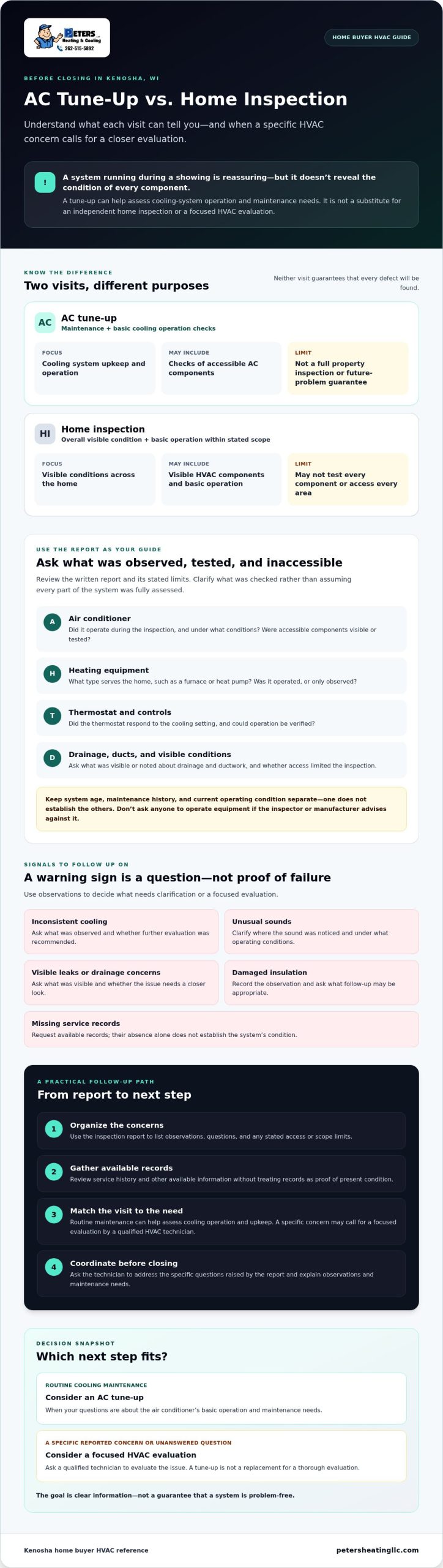
A clear follow-up process turns an inspection note into a useful next step. It also separates maintenance from diagnosis: an AC tune-up is for routine upkeep, while a technician’s service visit may be appropriate when you need a specific concern assessed. Neither visit guarantees future performance or determines how an inspection finding should affect purchase negotiations.
- Review the inspection report. Mark each HVAC observation, recommendation, and limitation. Note whether the report describes an operating concern, a visible condition, or an area the inspector couldn’t access.
- Gather available records. Ask the seller for equipment documents, service records, and repair invoices. Note when information is unavailable instead of assuming why.
- Identify your questions. Separate routine maintenance recommendations from unresolved concerns. For example, ask whether a reported leak needs diagnosis or whether a suggested tune-up is general upkeep.
- Arrange the right evaluation. Share the report with a qualified HVAC technician and explain what you need clarified. Confirm whether the visit is for maintenance or assessment of a specific issue.
- Document the findings. Request clear notes about observations, recommendations, limitations, and suggested follow-up. Keep them with the inspection report and share them with your real-estate professionals as appropriate.
Prepare questions and coordinate access
Before scheduling, gather the inspection report, equipment labels if available, service records, and information provided by the seller. Ask which findings may need attention and which are maintenance recommendations. Coordinate access and timing with the seller and your real-estate professionals, including permission for the technician to enter and examine the equipment. A written summary can clarify what was assessed, but it does not settle transaction terms.
Consider the home’s actual history
Ask about the installed equipment, past service, and how the system has operated through the seasons. Kenosha’s humid summers and cold winters provide context for questions about cooling and heating performance, but local weather alone does not show that a system is defective. The equipment type and its documented condition are more useful than assumptions based on location.
If a report identifies a repair question, the Kenosha HVAC repair guide may help you understand what to discuss with a technician. For routine upkeep, Peters Heating & Cooling provides HVAC preventative maintenance. If you’re looking for an AC tune up Kenosha WI, ask about scheduling an AC tune-up, and clarify whether your inspection concern needs a separate service assessment.
After the HVAC Inspection: Choose the Right Next Step for Your Kenosha Home
An inspection report helps you understand what was visible and operating during the home inspection. If it flags a service concern, an HVAC technician can assess that issue during a separate visit. The most useful next step depends on the finding, not on a one-size-fits-all rule.
Use the report and available records to choose a practical response:
- Routine maintenance: If the equipment appears to operate normally and the concern is general upkeep, plan maintenance after you take ownership. A tune-up supports scheduled care, but it cannot promise a particular efficiency gain, prevent every repair, or extend equipment life by a set amount.
- Repair assessment: If the report identifies a specific operating problem, visible damage, or an unresolved concern, ask a qualified technician to evaluate it. Share the inspector’s notes so the visit can focus on the issue.
- Records request: If the service history is unclear, ask the seller for available maintenance records, repair invoices, or equipment documents before drawing conclusions.
- No immediate action: If the report identifies no unresolved concern, you may decide to keep the findings and plan routine maintenance later. That choice is not a guarantee of future performance.
Plan maintenance around the equipment
Once you own the home, an AC tune-up may be a sensible way to begin a maintenance routine, especially if the service history is incomplete. Before booking, ask what the visit includes, what it excludes, and how the technician will communicate observations or recommended follow-up. For a general overview of upkeep, review this seasonal HVAC maintenance guide covering what to check and when.
Choose a provider with clear answers
Ask whether the company serves the property’s location and works on its equipment type. Confirm whether the visit is for routine maintenance or a focused evaluation of an inspection finding. Clarifying the scope beforehand sets expectations and makes it easier to compare the technician’s notes with the home inspection report.
Peters Heating & Cooling provides residential HVAC maintenance and service, including AC tune-ups, in Kenosha. If you’re considering an AC tune up Kenosha WI for a home you’re buying, discuss the equipment and your specific questions before scheduling. Contact Peters Heating & Cooling to discuss the home’s HVAC service needs.
Make Your HVAC Next Step With Confidence
A home inspection gives you a broader view of visible conditions, while an HVAC technician can assess a specific service concern. Keep those roles distinct, review the report and available records, and decide whether the equipment needs a repair evaluation, routine maintenance, or no immediate follow-up.
If you’re planning an AC tune up Kenosha WI after buying, treat it as a maintenance step, not a guarantee against future problems. Ask what the visit covers and how the technician will explain any findings. Clear answers help you plan without assuming more than the evaluation can confirm.
Peters Heating & Cooling is locally owned and operated, serving the community since 2009. Its technicians are licensed, insured, and continuously trained. Maintenance visits are flat-rate tune-ups, with transparent pricing as a stated business practice.
Have questions about the home’s equipment or which service visit may fit? Contact Peters Heating & Cooling to discuss an HVAC service visit. A thoughtful next step can help you settle into your new home with greater confidence.
Frequently Asked Questions
Does a home inspection include a full HVAC inspection?
No, a general home inspection does not automatically include a full technical HVAC evaluation. Depending on the inspector’s scope and access, it may cover visible components and basic operation. Read the written report to see what was checked and what could not be assessed. If it notes an unresolved concern or leaves an important question unanswered, ask a qualified HVAC professional whether a separate evaluation makes sense.
Should I get an AC tune-up before buying a house?
Possibly, but a tune-up is routine maintenance, not a replacement for a home inspection or a diagnosis of a specific problem. Consider asking a technician to assess the cooling system if the inspection report identifies a concern or the service history is unclear. Before arranging an AC tune up Kenosha WI, coordinate access with the seller and clarify whether the visit covers maintenance or an evaluation of the reported issue.
Can an AC tune-up find every problem with a system?
No routine maintenance visit can guarantee that every existing or future issue will be found. What a technician can assess depends on equipment access, operating conditions, system condition, and the agreed scope of the visit. Ask which conditions were observed, which checks were completed, and whether anything needs additional testing. That distinction helps you understand what the visit did and did not establish.
What should I ask about the HVAC system before closing?
Ask what type of heating and cooling equipment serves the home, what service records are available, and what the inspector observed or could not assess. Request clarification about any noted concern and ask what follow-up is recommended. You can also ask the seller for maintenance records or repair invoices. Treat equipment age as one detail among several, not a verdict on its present condition or replacement timing.
When is the best time to schedule an AC tune-up in Kenosha, WI?
Homeowners often plan cooling maintenance before regular seasonal use, but timing depends on the equipment’s needs and the provider’s availability. During a home purchase, first coordinate property access and follow up on specific inspection findings. If you’re arranging an AC tune-up in Kenosha, Racine, Oak Creek, or Winthrop Harbor, confirm service availability and scheduling directly with the provider rather than assuming a particular appointment window.
Does a newer air conditioner still need a tune-up?
Newer equipment may still need maintenance based on the manufacturer’s guidance and its service history. A tune-up does not prove that the system is free of defects, and it does not replace maintenance or documentation requirements tied to the equipment’s warranty. Review the available records and model information, then ask a qualified technician what upkeep is appropriate for that air conditioner.
What happens if the home inspector finds an HVAC concern?
Start by reviewing the written finding and asking what the inspector could not assess. If the concern remains unresolved, discuss arranging a focused evaluation with the seller and your real-estate professionals so access and timing are clear. A technician can explain observed conditions, the visit’s limits, and possible next steps. Use those findings to inform your decisions without assuming a particular repair cost or transaction outcome.