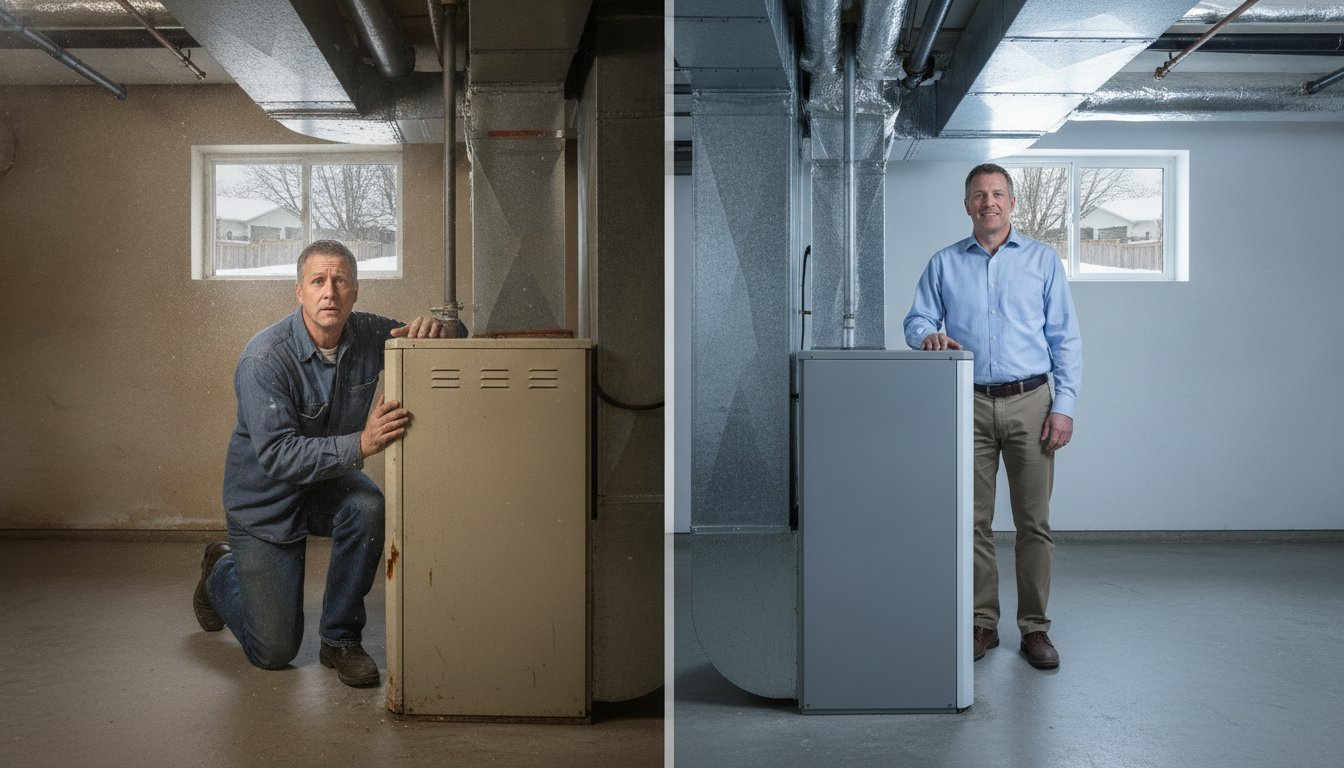
Is your furnace a reliable source of warmth or just a mounting debt sitting in your basement? When the temperature drops in Kenosha or Racine, the last thing you need is a sudden breakdown and a technician giving you conflicting advice. Deciding between a quick fix and a total system upgrade is often a source of major stress for homeowners. You want to be sure you’re making the most practical choice for your wallet and your family’s comfort. Understanding the furnace repair vs replacement cost is the first step in moving from uncertainty to a clear, logical plan.
We understand that home maintenance feels like a balancing act between immediate costs and long-term reliability. It’s frustrating to watch your energy bills climb while your old unit struggles to keep up. This guide provides a straightforward, math-based approach to help you decide when to stop repairing and start upgrading. You’ll learn how to apply the “50% rule,” evaluate the impact of 2026 efficiency standards, and calculate the real savings of a high-efficiency system. Our goal is to give you the honest information you need to find peace of mind and lower your monthly utilities.
Key Takeaways
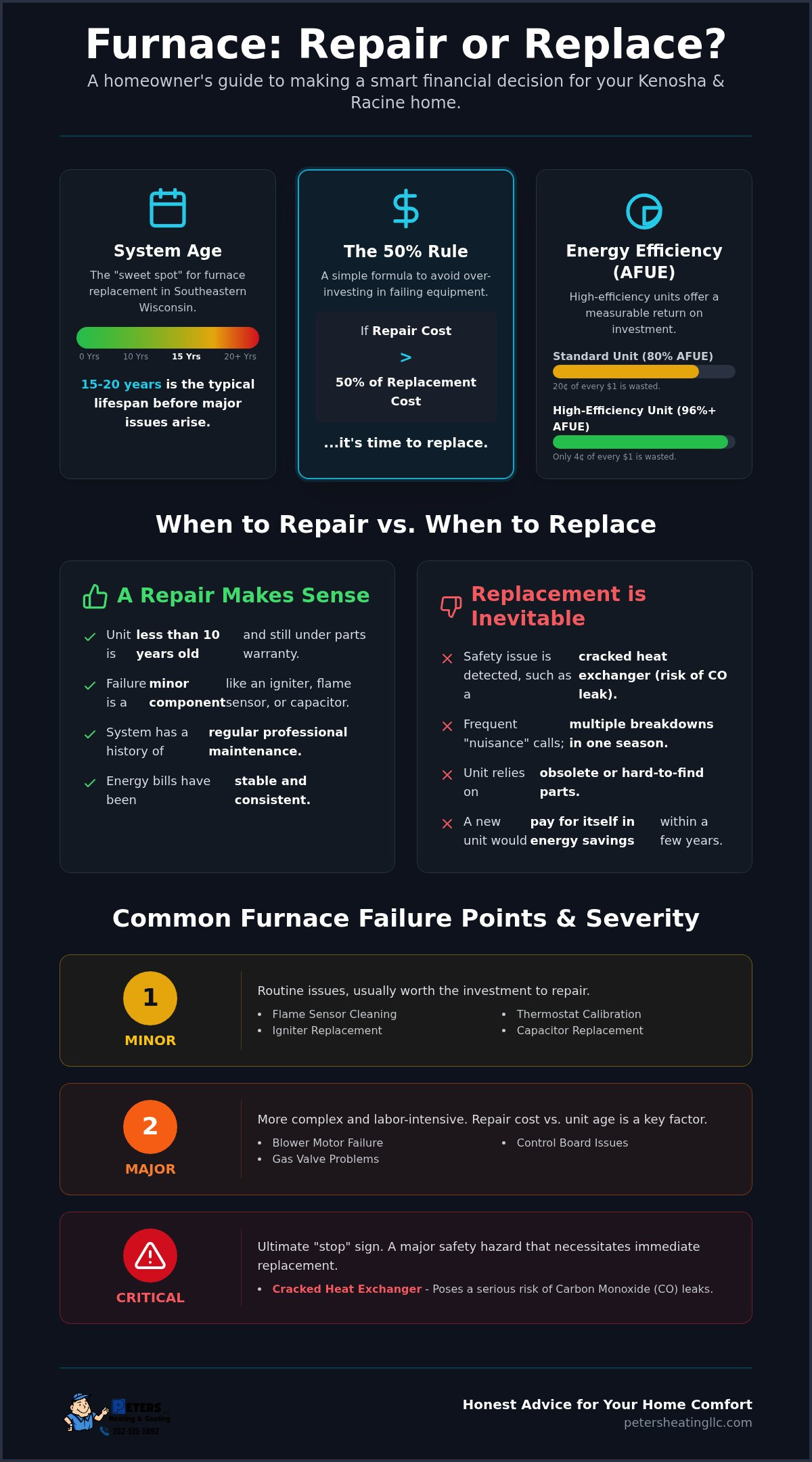
- Identify the “sweet spot” for furnace replacement in the Kenosha area, typically when a unit reaches 15 to 20 years of age.
- Use the 50% Rule and the “Age x Repair” formula to accurately calculate your furnace repair vs replacement cost and avoid wasting money on failing equipment.
- Learn how moving from a standard 80% AFUE unit to a 96%+ high-efficiency system provides a measurable return on investment through lower monthly energy bills.
- Understand common failure points like blower motors and control boards to determine if a repair is a lasting solution or just a temporary fix.
- Discover how local climate factors in Southeastern Wisconsin influence heating system stress and why honest, tech-managed advice is your best tool for making a decision.
The Furnace Crossroads: Understanding the Repair vs. Replace Dilemma
Facing a broken furnace in the middle of a Wisconsin winter is a high-pressure situation. You’re forced to choose between the immediate savings of a repair and the long-term reliability of a new unit. This decision often creates significant emotional stress, as both options require a financial commitment. At Peters Heating & Cooling, we believe the best choice is always the one that provides the most practical value for your specific home. We’ve seen many homeowners feel paralyzed by the fear of making a “wrong” expensive choice, but we’re here to help you look at the facts.
In the Kenosha and Racine area, the “sweet spot” for furnace age is typically between 15 and 20 years. Because our winters are long and demanding, components in your central heating system work harder than they would in milder climates. By 2026, new energy standards and the phase-out of older refrigerants have made modern systems more attractive than ever before. While a repair might get you through the night, it won’t fix the underlying inefficiency that drives up your monthly utility bills. Calculating the furnace repair vs replacement cost means looking beyond today’s invoice and considering what you’ll pay over the next five years. You have to balance the comfort of a reliable system against the gamble of an aging one.
When a Repair Makes the Most Sense
Sometimes, fixing what you have is the smartest move. If your unit is less than 10 years old, it’s likely still covered under a manufacturer’s parts warranty. In these cases, you’re only responsible for the labor, which makes the repair much more affordable. We often recommend repairs when:
- The issue involves a minor component like a flame sensor, capacitor, or igniter.
- The system has a documented history of professional preventative maintenance.
- The overall mechanical health of the unit remains high despite the current glitch.
When Replacement Becomes Inevitable
There are moments when continuing to repair an old system is simply throwing good money after bad. Safety is our primary concern. If a technician detects a cracked heat exchanger, the risk of carbon monoxide leaks makes replacement a necessity rather than an option. You should also consider a new installation when:
- Your furnace relies on obsolete parts that are no longer in production.
- You’re experiencing “nuisance” service calls every few months during the peak of winter.
- The total furnace repair vs replacement cost analysis shows that a new unit would pay for itself through energy savings within a few seasons.
Common Furnace Repair Costs and Failure Points
Every mechanical system has a finite lifespan. When yours stops working on a sub-zero night, the first step is a diagnostic visit. At Peters Heating & Cooling, our technicians prioritize a clear, honest assessment of your unit’s condition. We believe in transparency, so you understand the technical failure before we discuss the solution. A single component failure is often an isolated incident, but multiple issues in one season suggest a deeper problem with the system’s integrity.
Common failure points include igniters, blower motors, and control boards. Igniters are essentially the spark plugs of your heating system and often wear out after several years of use. Blower motors and control boards are more complex and require licensed technicians to handle the precision electrical work. Attempting a DIY fix on these parts can lead to safety hazards or further damage to the unit. When we evaluate the furnace repair vs replacement cost, we look at the labor-to-part ratio. If a major component fails on an older unit, the labor required to install it often makes the repair a poor long-term investment.
One failure is an accident; three in a single season is a warning sign. The “hidden” cost of multiple small repairs often exceeds the price of a down payment on a new system. These “nuisance” calls add up quickly, especially when you factor in the stress of repeated breakdowns. If you’re currently hearing strange noises or feeling cold spots, it’s time for an expert furnace repair assessment to see where your system stands.
Minor vs. Major Repair Categories
We categorize repairs to help you visualize the severity of the issue. Minor repairs include thermostat calibration, sensor cleaning, or belt replacements. These are routine and usually worth the investment. Major repairs involve blower motors or gas valve issues, which are more labor-intensive. Critical failures, specifically a cracked heat exchanger, are the ultimate “stop” sign. Because modern energy conservation standards have changed how systems operate, fixing a critical failure on an obsolete unit is rarely the most practical choice.
The Impact of Neglected Maintenance
Many expensive failures are entirely preventable. For example, a dirty filter restricts airflow, forcing the blower motor to work twice as hard. This extra strain leads to premature motor failure and higher energy bills. Seasonal tune-ups identify these small issues before they turn into mid-winter emergencies. You can learn more about how to protect your system by reading about The Value of a Seasonal HVAC Maintenance Visit. Consistent care is the most effective way to keep your furnace repair vs replacement cost low over the life of your home.
Evaluating Furnace Replacement Costs and Long-Term Value
Thinking about a new furnace often brings up concerns about the total price tag. When you compare the furnace repair vs replacement cost, it’s easy to focus only on the initial quote. However, a new installation is an investment in your home’s infrastructure that yields returns over many years. The primary factors that influence this price are the unit’s size, measured in BTUs, and its Annual Fuel Utilization Efficiency (AFUE) rating. A higher AFUE means more of the fuel you pay for actually turns into heat. For instance, moving from an old 80% AFUE unit to a modern 96% model means you’re wasting significantly less energy every month.
Financing helps many families manage these unexpected costs. We offer flexible options to help bridge the gap between an expensive repair and a necessary upgrade. Instead of paying a large sum for a temporary fix on an old unit, you can invest that money into a reliable system with a predictable monthly payment. In the Kenosha and Racine area, our team also handles the specific labor and permit requirements needed for a safe, legal installation. We take care of the technical details and local compliance so you can focus on your family’s comfort.
The Real Cost of Installation
The “box price” you might see online rarely reflects the final installed price. A professional installation includes specialized labor, venting modifications, and ductwork adjustments to ensure the unit operates safely. We use a Manual J calculation to determine the exact size your home needs. An oversized furnace will cycle on and off too frequently, while an undersized one will never keep you warm. You can find a detailed breakdown in our guide on What to Expect: New Furnace Installation Costs. Proper sizing is the only way to ensure the efficiency you’re paying for actually happens.
Energy Savings and Rebates in 2026
While federal tax credits under Section 25C expired at the end of 2025, many local utilities still offer rebates for ENERGY STAR certified furnaces. These incentives directly lower your net cost of replacement. When you combine these rebates with the lower monthly utility bills provided by a high-efficiency system, the long-term value becomes clear. Modern units are designed to maximize every dollar you spend on heating. Even without federal credits, the monthly reduction in your gas bill often makes the upgrade the most practical financial choice over the next decade.
The 50% Rule: A Decision Framework for Homeowners
Making a choice based on a gut feeling is risky when your home’s comfort is at stake. We prefer a methodical approach that removes the guesswork from the furnace repair vs replacement cost debate. When a technician provides a quote, we encourage you to apply the 50% rule. If the cost of the repair exceeds 50% of the price of a new unit, investing in an upgrade is almost always the more practical financial move. This rule protects you from sinking significant capital into a system that may still fail elsewhere in the near future.
Another helpful tool is the “Age x Repair” formula. You simply multiply the age of your furnace by the cost of the current repair estimate. If the total is greater than $5,000, replacement is the recommended action. For example, an $800 repair on a 10-year-old unit equals $8,000, suggesting that your money is better spent on a new system. We also suggest a “three strikes” rule. If your furnace has required three separate service calls in a single winter, the system’s reliability has been compromised. Looking at the total cost of ownership over the next five years often reveals that a new unit is cheaper than constant maintenance on an old one.
Repair vs. Replace Comparison Table
Every home is different, but these general guidelines help clarify the “grey areas” where a decision feels difficult. Our team at Peters Heating & Cooling prioritizes honesty; we won’t push for a replacement if a simple repair will safely extend the life of your unit for several more years.
| Unit Age | Repair Cost | Recommended Action |
|---|---|---|
| Under 10 Years | Any | Repair (likely under warranty) |
| 12-15 Years | Over $1,500 | Replacement is often better |
| 18+ Years | Over $500 | Replace due to age and efficiency |
Factoring in Future Home Plans
Your long-term goals for your property should also influence your decision. If you plan to stay in your Kenosha or Racine home for the next decade, the energy savings of a new unit will eventually pay for the installation. However, even if you’re planning to sell, a new HVAC system is a major selling point that increases home resale value. Buyers in Southeastern Wisconsin look for the peace of mind that comes with a reliable heating system. Knowing you won’t face a breakdown during a sub-zero night is a value that’s hard to put a price on. If you’re unsure which path to take, schedule a professional furnace evaluation to get a clear, honest look at your options.
Why Local Expertise Matters for Your Heating Decision
Living near Lake Michigan means our heating systems face challenges that national averages simply don’t account for. The high moisture levels in the air combined with deep, sustained winter freezes create a demanding environment for mechanical equipment. This regional stress often leads to premature corrosion or component fatigue. When you’re weighing the furnace repair vs replacement cost, you need an assessment that considers these specific local conditions. A furnace in Kenosha or Racine works harder and deals with more humidity than a unit in a drier climate, which directly impacts its reliable lifespan.
Working with a local, tech-managed company like Peters Heating & Cooling provides a level of insight that generic advice cannot match. Don and Mike are technicians first, which means our recommendations are rooted in mechanical reality rather than sales targets. We’ve seen how different brands and models hold up against Wisconsin winters over the last decade. Our goal is to provide no-nonsense advice that prioritizes your safety and comfort. We believe in transparent pricing and clear explanations, so you never feel pressured into a decision that doesn’t make practical sense for your home.
The Peters Heating & Cooling Difference
Since 2009, we’ve built our reputation on neighborly care and technical precision. When you call us, you’re getting direct access to experienced professionals who treat your home with the same respect they’d show their own. Our “Honest Guide” promise is simple: we provide the most practical solution, even if it isn’t the most expensive one. We understand the stress of a failing furnace, and we’re here to provide a steady, reassuring hand. Our legacy in the community is built on long-term trust, not immediate sales.
- Direct access to senior technicians like Don and Mike.
- A deep understanding of SE Wisconsin and NE Illinois climate impacts.
- Commitment to ethical responsibility and transparent communication.
Schedule Your Diagnostic Today
The first step toward a reliable home is a thorough professional evaluation. During a diagnostic visit, we don’t just look at the broken part; we assess the overall health of your system, including the heat exchanger, blower motor, and venting. We provide clear, written quotes for both repair and replacement options, allowing you to compare the furnace repair vs replacement cost side-by-side. This data-driven approach ensures you can make a choice that fits your budget and your long-term goals. If you’re ready for an honest assessment of your heating system, you can book your furnace inspection in Kenosha or Racine today. We’ll help you find the most efficient path to a warm, worry-free winter.
Secure Your Comfort for the Seasons Ahead
Deciding on the best path for your heating system is ultimately about balancing today’s budget with tomorrow’s reliability. By using the math-based frameworks we’ve discussed, you can turn a confusing technical problem into a clear financial choice. Understanding the furnace repair vs replacement cost ensures you aren’t just patching a failing unit; you’re investing in a system that lowers your monthly utility bills and provides lasting peace of mind.
Peters Heating & Cooling has served Kenosha, Racine, and Winthrop Harbor since 2009 with a commitment to integrity. We’ve earned our reputation by providing no-pressure, transparent pricing that local homeowners can depend on. Our team is ready to help you evaluate your options without the stress of a high-pressure sales pitch. We treat every home as if it were our own, ensuring you receive the most practical advice for our unique Wisconsin climate.
Get an Honest Furnace Evaluation from Peters Heating & Cooling
You don’t have to face the next cold snap with uncertainty. We’re here to help you keep your home warm and your family safe all winter long.
Frequently Asked Questions
How long does a typical furnace last in Wisconsin?
In the demanding climate of Kenosha and Racine, a well-maintained furnace typically lasts between 15 and 20 years. Our long, sub-zero winters put more stress on the blower motor and heat exchanger than in milder regions. While some units can push past the two-decade mark, their efficiency usually drops significantly as they age. Regular preventative maintenance is the only reliable way to ensure your system reaches its maximum lifespan without unexpected mid-winter breakdowns.
Is a $1,000 repair worth it on a 12-year-old furnace?
Generally, a $1,000 repair on a 12-year-old unit is not the most practical choice. If you apply the “Age x Repair” formula, the result is $12,000, which is well over the $5,000 threshold for replacement. When evaluating the furnace repair vs replacement cost, you have to consider that an older unit is more likely to face another failure soon. Investing that money into a new, high-efficiency system often provides better long-term value and reliability.
What are the signs that my furnace is about to fail completely?
You should watch for several warning signs, including loud banging or screeching noises, frequent cycling, and cold spots throughout your home. If your gas bills are rising without a change in usage, your system is likely struggling to maintain temperature. Another red flag is a pilot light that frequently goes out or a yellow flame instead of a steady blue one. These issues often indicate that the internal components are reaching the end of their functional life.
Do new furnaces really save that much on monthly gas bills?
Yes, the savings can be substantial, particularly if you’re upgrading from an older 80% AFUE unit to a modern 96% or higher model. This means that 96 cents of every dollar spent on gas is converted into heat for your home. Over a long Wisconsin winter, these monthly reductions add up quickly. While the initial furnace repair vs replacement cost might seem high, the lower operational expenses help the new system pay for itself over time.
Can I finance a new furnace installation through Peters Heating & Cooling?
We offer flexible financing options to help our neighbors in Oak Creek and Winthrop Harbor manage the cost of a new system. We understand that a furnace replacement is often an unexpected expense that can strain a household budget. Our team provides transparent quotes and helps you find a payment plan that fits your financial situation. This allows you to prioritize your family’s safety and comfort without needing to pay the full amount upfront.
What is the most expensive part to repair on a furnace?
The heat exchanger is typically the most expensive component to replace. It’s the heart of the system where the actual heating occurs. If it cracks, the unit becomes a safety hazard and usually requires a total replacement. Other high-cost parts include the blower motor and the main control board. Because the labor required to replace these parts is extensive, we often recommend looking at a new installation instead of a costly repair on an aging unit.
Will a new furnace increase my home value?
A new, high-efficiency heating system is a significant asset for any home in Southeast Wisconsin. Potential buyers in Kenosha and Racine prioritize reliability and low utility costs when looking at properties. Having a modern furnace with a documented maintenance history provides peace of mind and can make your home much more competitive on the market. It shows that the property has been well-cared for and won’t require immediate, expensive mechanical upgrades after the sale.
How do I know if my heat exchanger is cracked?
A cracked heat exchanger is difficult for a homeowner to detect without professional tools. Warning signs include a buildup of soot inside the furnace, a strong odor similar to formaldehyde, or water pooling around the base of the unit. If your carbon monoxide detector goes off, you must shut down the system immediately and call for a licensed technician. We use specialized cameras and sensors during our diagnostic visits to identify these dangerous cracks accurately.