
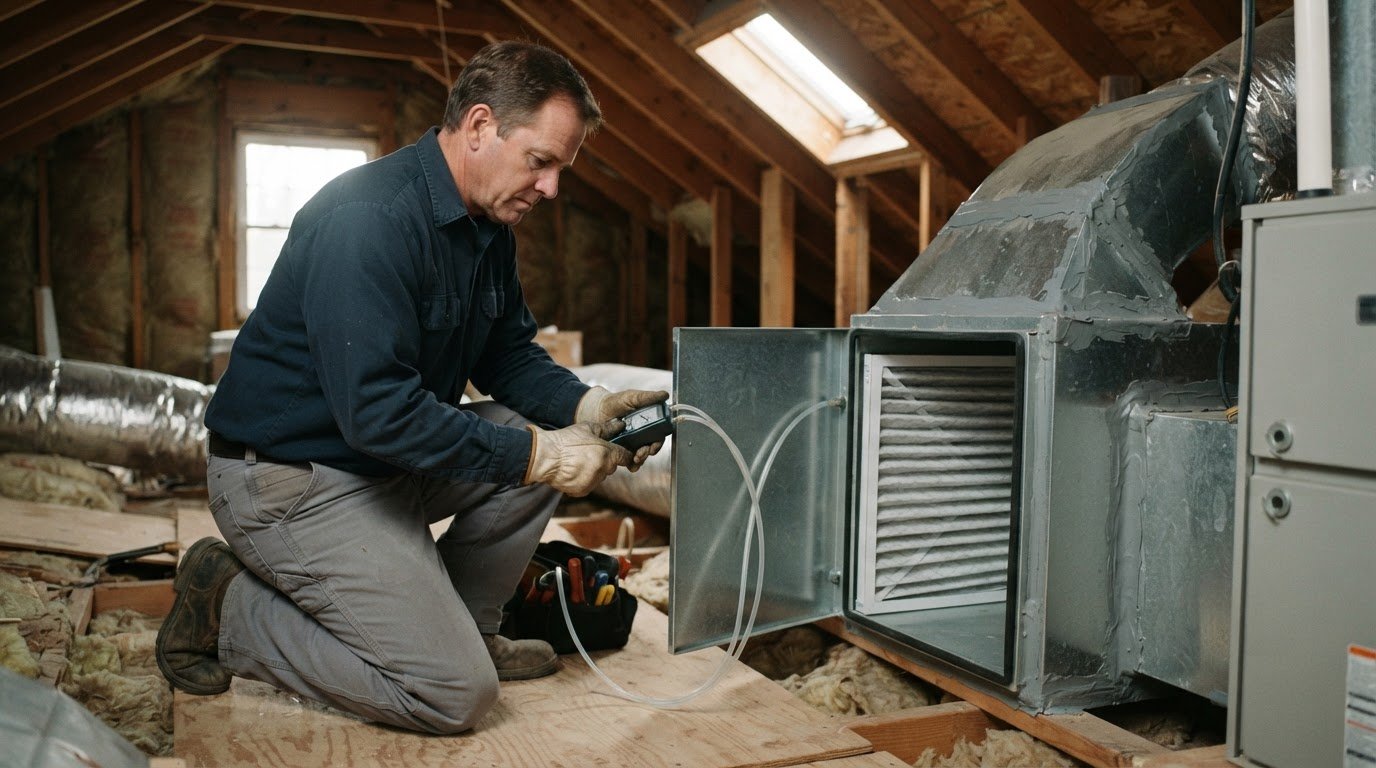
Indoor air can be up to five times more polluted than outdoor air, but that doesn’t mean every home needs a whole-home purifier. The EPA recommends a furnace or HVAC filter rated at least MERV 13, or as high a rating as the system’s fan and filter slot can accommodate. Whole-home air purification installation in Kenosha, WI may be worth considering when dust or pollen remains a concern and your HVAC system can support the added equipment.
If you’re looking for whole-home air purification installation in Kenosha, WI, the system needs to work with your home’s heating and cooling equipment, not just treat one room. Filtration, ductwork, and airflow all affect performance. Here’s what to consider when deciding whether an in-duct system is a practical fit for your home.
Key Takeaways
- Match filtration to what your HVAC system can handle; the EPA recommends at least MERV 13 when the fan and filter slot can accommodate it.
- Consider ductwork condition and airflow, since limitations can affect how well whole-home air quality improvements work.
- Learn how an in-duct purification system works with your existing HVAC equipment.
- Understand when an air purifier may be a useful part of addressing dust and pollen concerns at home.
Air filtration for allergies, dust, and pollen
Indoor air can be up to five times more polluted than outdoor air. A compatible HVAC filter can help reduce airborne particles as air circulates through your home.
Indoor Contaminants and Allergy Irritation
Common asthma triggers include smoke, mold, pet dander, dust mites, and pests. These contaminants can circulate indoors and may irritate people with allergies or asthma. Start by identifying what concerns your household. Visible dust near a return vent, for example, may point to a different issue than seasonal pollen entering through open windows.
Effectiveness, Maintenance, and Operating Costs
Whole-home filtration can capture airborne particles, but results depend on the filter, airflow, and HVAC system condition. A filter does not remove contaminants that have settled on surfaces, and no single system should be assumed to eliminate every allergen, smoke particle, mold source, or virus. Ongoing costs depend on filter replacements, equipment operation, and maintenance needs.
Dust and pollen control begins with particles reaching the HVAC filter. Return ducts carry indoor air through the system, where a compatible filter can capture some particles before the air circulates again. Particles that never enter the return path, such as pollen on clothing or dust on furniture, require other cleaning steps. Filtration is one part of a broader approach.
Filter upkeep matters because collected debris can restrict airflow. Follow the filter manufacturer’s replacement guidance, taking household conditions such as pets, renovation dust, and frequent heating use into account. A clogged or poorly fitted filter can leave gaps around its edges or impede air movement, affecting both particle capture and system operation.
Operating costs vary with equipment runtime, filter type, and replacement frequency. Higher-efficiency filters may need more careful matching to the HVAC system’s fan and filter slot. Regular maintenance helps assess filter condition and airflow instead of relying on a calendar alone. If smoke or mold is a persistent concern, filtration does not replace addressing the source.
Ductwork condition and airflow limitations
Whole-home purification depends on how air moves through the house. Duct condition, HVAC equipment, and available installation space all affect compatibility and performance.
An in-duct purifier requires ductwork connected to a forced-air heating or cooling system. Compatibility also depends on whether the system fan can move air through the equipment and whether there is a suitable installation location. A boiler-only home without ducts has no duct location for an in-duct purifier. These factors help determine whether the existing setup can support this type of installation.
Older Kenosha homes without original ductwork may have airflow limitations that affect indoor air improvements. Additions, remodeled rooms, or changes to the heating layout can also leave some spaces with different air circulation. A room far from a supply register, for example, may receive less conditioned air than one near the main duct run. An air purifier cannot correct an airflow problem by itself.
A ductwork assessment considers the route from the HVAC unit to supply registers and return grilles. Technicians look for visible damage, disconnected sections, obstructions, and differences in airflow between rooms. The fan and filter area matter too, since an added device needs space within the system. These checks help identify whether the limitation is installation space, ductwork, or equipment.
Uneven heating or cooling, weak airflow at a register, and persistent dust around a vent are signs worth investigating. Each can have different causes. A blocked return, damaged duct, or equipment limitation calls for a different response than simply adding purification equipment.
A focused review of duct layout and airflow can clarify the next step. Review HVAC airflow and ductwork before choosing an in-duct approach.
Annual professional HVAC maintenance allows technicians to monitor component condition and recommend preventative replacements.
Replacing an air conditioner expansion valve typically takes two to three hours, depending on accessibility and whether additional repairs are needed.
Higher-efficiency filtration for pollen and dust
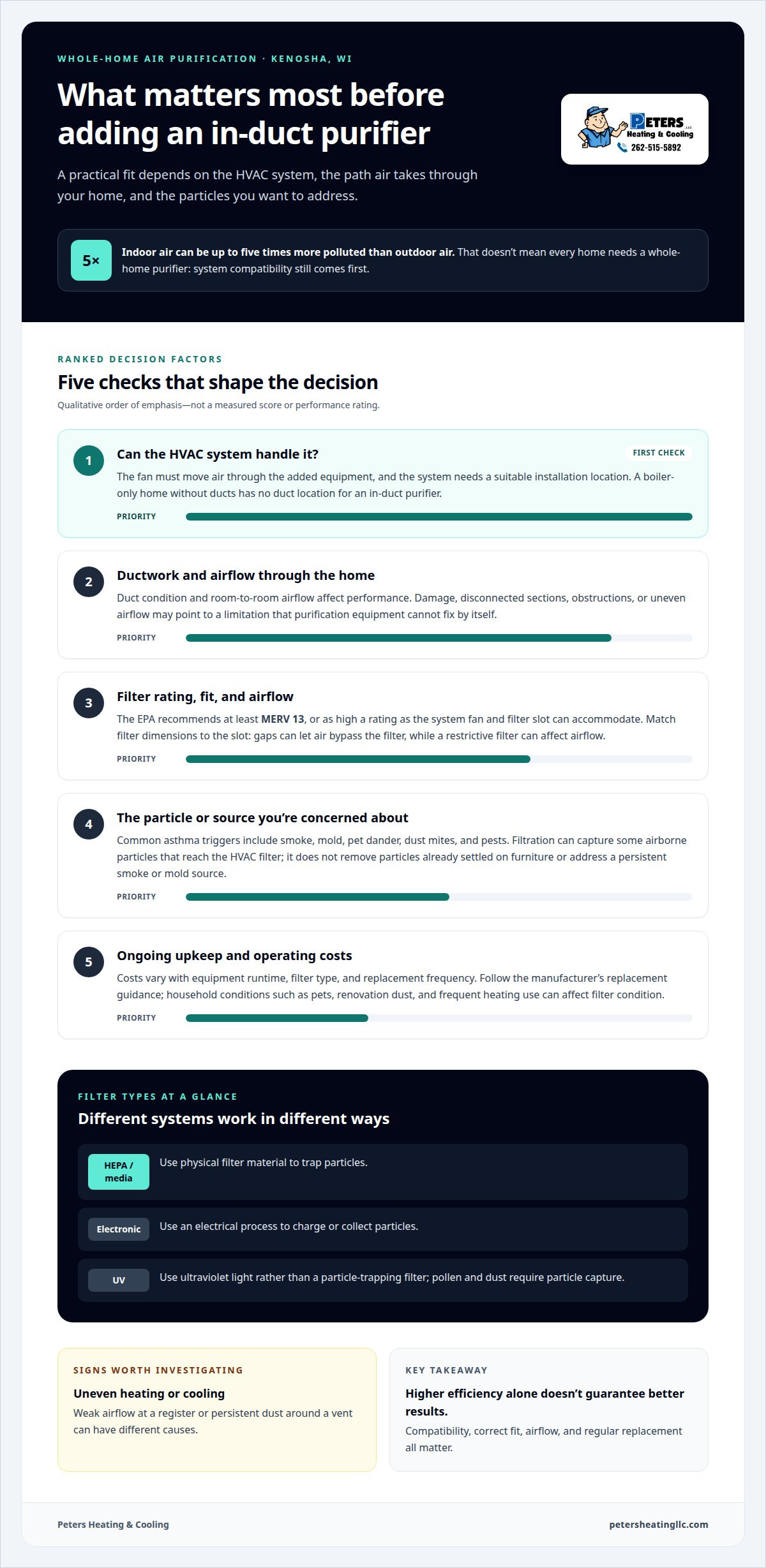
Filter efficiency describes how well a filter captures particles passing through it. A higher rating can help capture airborne pollen and dust, but the furnace fan and filter slot set practical limits. The filter must fit correctly and allow suitable airflow through the heating system.
According to the U.S. Environmental Protection Agency, choose a furnace or HVAC filter rated at least MERV 13, or as high a rating as the system fan and filter slot can accommodate. That recommendation makes compatibility central: the highest available rating is not automatically the right choice if the equipment cannot handle it.
MERV ratings help compare filters designed to capture particles. Check the rating printed on the filter and match its dimensions to the existing slot. Gaps can let air bypass the filter, while a filter that restricts airflow can affect system operation. Dust buildup also changes how air passes through the filter, so follow its replacement guidance.
HEPA, electronic, UV, and media systems work in different ways. HEPA and media options use physical filter material to trap particles. Electronic systems use an electrical process to charge or collect particles, while UV systems use ultraviolet light rather than a particle-trapping filter. The distinction matters: pollen and dust require particle capture, while UV equipment serves a different purpose.
For seasonal pollen, a correctly fitted HVAC filter may be a straightforward starting point. Finer filtration requires considering the system’s fan capacity, filter opening, and airflow together. Furnace installation or repair can also be a good opportunity to assess the filter setup as part of the equipment work.
Higher efficiency alone does not guarantee better whole-home results. A filter’s performance depends on fit, airflow, and regular replacement. If dust continues to collect around a register, the cause may involve duct leakage or circulation rather than the filter rating. Matching the filter to the system helps avoid treating one symptom as the whole problem.
Whole-home air purification installation
In-duct purification works with a home’s existing forced-air HVAC system. Whole-home air purification installation in Kenosha, WI starts with assessing the equipment type, duct access, and available airflow. For example, the Reme Halo is installed inside an existing HVAC duct system and releases ionized hydrogen peroxide molecules when the HVAC unit turns on. This assessment helps determine whether the setup suits the home.
The installation plan then accounts for equipment placement and connection to the HVAC unit. The technician reviews the duct section, considers system airflow, and follows the equipment’s installation requirements. After installation, operation can be checked while the HVAC system runs. Planning whole-home air purification installation in Kenosha, WI around these steps helps match the equipment to the home’s duct layout.
Permit, code, and rebate requirements depend on the equipment and scope of work. They do not automatically apply to every air-purifier project, so an assessment should clarify which requirements apply before installation begins.
When choosing an HVAC company in Kenosha, Racine, Oak Creek, or Winthrop Harbor, look for a team that assesses purifier compatibility, duct access, and airflow. These factors matter more than choosing a device by name alone. A home with a boiler and no ductwork, for example, needs a different indoor-air approach than a home with a forced-air furnace.
Electronic air cleaners collect particles through an electrical process and may require cleaning or maintenance. Ozone-generating purifiers introduce ozone, so understand the technology and its intended use before choosing one. Consider whether the equipment captures particles, uses another treatment method, or generates ozone.
Before scheduling work, clarify the purifier type, proposed duct location, compatibility, and upkeep requirements. This gives the project a clear scope and helps avoid equipment that doesn’t suit the home. Plan an in-duct air purification installation around your HVAC system and duct layout.
Peters Heating & Cooling
Peters Heating & Cooling can help assess HVAC conditions that affect a whole-home air purification plan. If uneven airflow, equipment trouble, or an aging heating or cooling system is part of the concern, the team can explain practical next steps based on the system’s condition.
That may involve furnace or air conditioning repair when existing equipment is not operating properly, or installation when replacement is the appropriate option. The goal is to understand how the HVAC system and ductwork relate to your indoor-air goals, without treating a purifier as a fix for every airflow or equipment issue.
If you’re weighing purification options for your home, contact Peters Heating & Cooling to discuss your HVAC system and the concerns you’re trying to address.
Make a Practical Plan for Cleaner Indoor Air
Start by connecting your indoor-air concerns with the condition of your HVAC equipment. Whole-home air purification installation in Kenosha, WI should suit your home’s actual ductwork and airflow, not just the result you hope to achieve. A system review can clarify whether filtration, purification, or HVAC repair deserves attention first.
If furnace or air conditioning problems affect system operation, Peters Heating & Cooling provides furnace repair, air conditioning repair, furnace installation, and air conditioning installation. The right direction depends on the equipment and your home, so a clear assessment helps keep the decision practical.
For a straightforward conversation about your home’s air quality and HVAC needs, contact Peters Heating & Cooling. A well-considered next step can make indoor comfort easier to manage.
Frequently Asked Questions
Do I Need An Air Purifier?
Whole-home purification may be worth considering if airborne dust or seasonal pollen remains a concern across several rooms. Recurring irritation during Kenosha’s outdoor allergy season, for example, may prompt you to explore whole-home filtration. First consider whether the issue comes from airborne particles, a specific indoor source, or dust already settled on surfaces. An air purifier is one tool, not a substitute for addressing the source.
What whole-home air purification systems are available for HVAC installation?
Options include media filters, HEPA filtration, electronic air cleaners, UV air treatment, and in-duct purification devices. They work in different ways: filters capture particles, electronic systems use an electrical process, and UV devices use ultraviolet light. The Reme Halo is an in-duct option that releases ionized hydrogen peroxide molecules when the HVAC unit turns on. System compatibility and your household’s air-quality goals help guide selection.
How long does whole-home air purifier installation take, and what are the steps?
Installation time depends on duct access, equipment placement, and the existing HVAC setup. The work generally involves reviewing the system, selecting a compatible location, installing the purifier in the ductwork, and checking its operation while the HVAC unit runs. An accessible duct near the furnace, for example, may present a different task than a cramped or obstructed duct section.