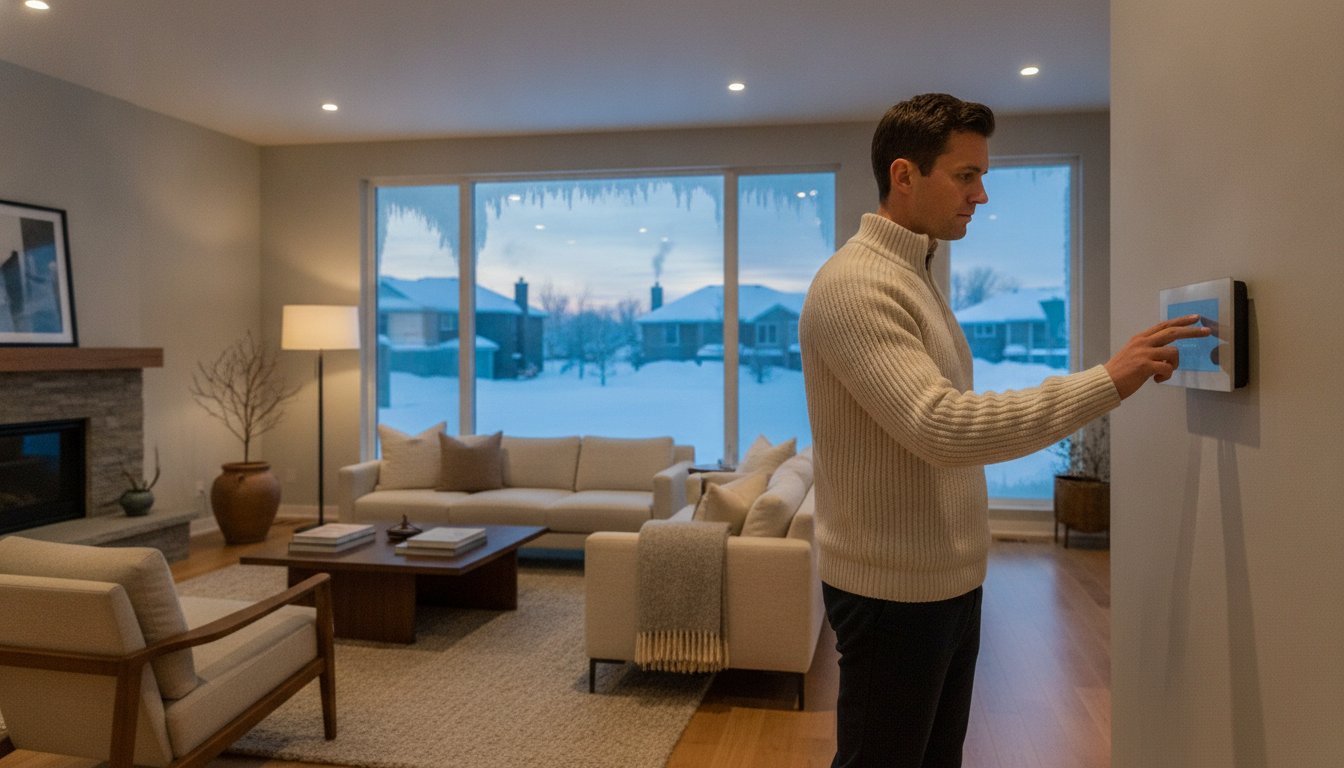
It’s 2 AM on a frigid January night in Kenosha, and instead of a cozy warmth, you wake up to a draft that feels like the front door was left wide open. You walk over to the vent only to find your furnace blowing cold air while the house temperature steadily drops. It’s a stressful moment for any homeowner. You might start worrying about expensive repair bills or whether you’ll need to find a hotel while you wait for a technician to arrive.
We understand that anxiety. At Peters Heating & Cooling, we believe in giving you honest, no-nonsense advice. The truth is that a furnace blowing cold air often means your system is working exactly as it should to protect itself. Many times, a safety sensor has tripped to prevent a more serious problem. You don’t always need a major repair to get the heat back on.
In this guide, we’ll help you identify the most common reasons for this issue. You’ll learn which simple fixes you can handle yourself, such as checking your thermostat settings or replacing a clogged filter, and when it’s time to call a licensed professional. Our goal is to help you restore your comfort safely without any unnecessary drama or high-pressure sales tactics.
Key Takeaways
- Start with the thermostat fan setting. If it is set to “On” instead of “Auto”, your furnace blowing cold air might just be the fan circulating room air between heating cycles.
- Discover how a clogged air filter can cause your system to overheat and trigger a safety shutdown of the burners.
- Identify the role of the flame sensor and why this small component is the leading technical reason for a furnace failing to stay lit.
- Use our five-step safety checklist to rule out simple power issues and thermostat errors before calling for a professional service visit.
- Learn to spot serious “Red Alert” symptoms that require immediate help from a licensed expert to keep your home safe.
Why Is My Furnace Blowing Cold Air? Check These 3 Things First
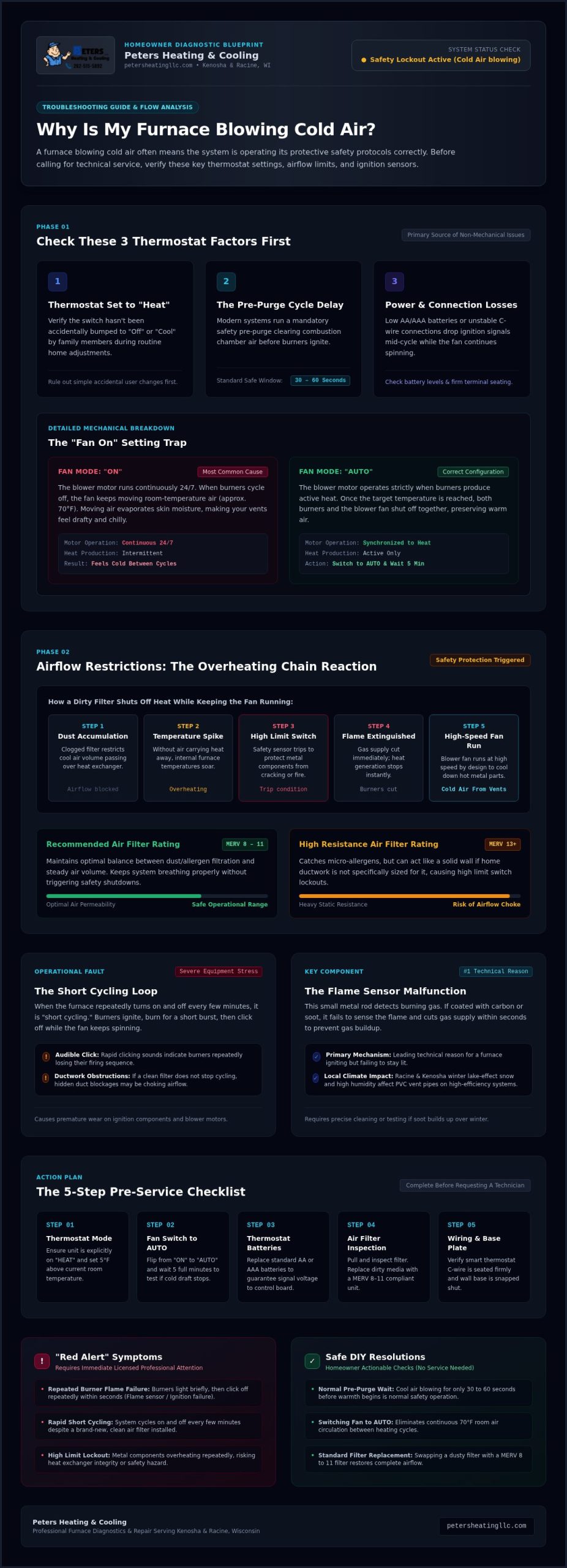
When you realize your house is getting colder, your first instinct might be to worry about a total system failure. However, many service calls in the Kenosha and Racine area result from simple setting errors. It’s often just a matter of checking the device on your wall before looking at the unit in your basement or utility closet. Before you assume the worst, verify that your thermostat is actually set to “Heat.” It sounds simple, but it’s easy for a family member to accidentally bump the switch to “Off” or “Cool” while adjusting the temperature.
You should also keep in mind that a brief period of cool air is normal during the start-up process. Modern systems go through a “pre-purge” cycle. This safety step clears out the combustion chamber before the burners ignite. This process usually lasts about 30 to 60 seconds. If the air doesn’t warm up after a minute or two, then you likely have a settings or hardware issue.
The “Fan On” Setting Trap
This is arguably the most common reason for a furnace blowing cold air. Your thermostat has a fan switch with two main settings: “On” and “Auto.” If it’s set to “On,” the blower motor runs 24/7 without stopping. It doesn’t matter if the burners are firing or if the house has already reached the desired temperature. When the furnace isn’t actively heating, the fan simply circulates room-temperature air through your vents. Because moving air causes moisture to evaporate from your skin, it feels chilly even if the air is 70 degrees. Switch the setting to “Auto” and wait five minutes. This ensures the fan only runs when the heat is actually being produced.
Thermostat Power and Connection Issues
Don’t ignore the batteries in your thermostat. Most digital models rely on two AA or AAA batteries to function. When these batteries get low, the display might still look fine, but the device loses the power needed to send a signal to the furnace control board. If the connection drops mid-cycle, the burners will shut off while the fan continues to spin, leading to a furnace blowing cold air until the fan finally stops.
If you recently installed a smart thermostat, check your wiring. These high-tech devices require a steady power source, often provided by a “C-wire” or common wire. Without a secure connection to the various central heating furnace components, the thermostat might reboot or fail to trigger the ignition sequence correctly. Ensure all wires are seated firmly in their terminals and that the thermostat is snapped tightly onto its wall base.
Airflow Restrictions: How a Dirty Filter Causes Cold Air
Many homeowners in Southeast Wisconsin assume a major mechanical failure when they feel a furnace blowing cold air. Often, the culprit is a simple air filter. Your filter’s job is to protect the blower motor and the heat exchanger from dust and debris. When it gets clogged, it restricts the volume of cool air passing over the heat exchanger. Without enough air to carry the heat away, the internal temperature spikes. This triggers the “High Limit Switch,” a safety device that kills the flame to prevent the metal from cracking or causing a fire.
Even though the fire is out, the blower fan will continue to run at high speed. This is by design. The system is trying to cool down those internal components as quickly as possible. During this time, you’ll feel room-temperature or cold air coming from your vents. Choosing the right filter is also vital. While high MERV ratings (13 or higher) catch more allergens, they can act like a wall if your ductwork isn’t sized for them. We usually recommend MERV 8 to 11 filters to keep your system breathing properly without causing a furnace blowing cold air lockout.
The Overheating Cycle (Short Cycling)
You might notice your furnace turning on and off every few minutes. This is called short cycling. You’ll hear the burners ignite, stay on for a short burst, and then click off while the fan keeps spinning. This constant cycling puts immense stress on your equipment. It’s a clear sign that the system is struggling to breathe. If you’ve replaced your filter and still hear this rapid clicking, it’s a good idea to have a professional furnace repair technician inspect your ductwork for other hidden obstructions.
Local Climate Impacts: Racine and Kenosha Winter Factors
Living near Lake Michigan means dealing with intense lake-effect snow and high humidity. For homeowners with high-efficiency furnaces, this creates a unique challenge. These systems use PVC pipes that vent out the side of your house. Heavy drifts or ice dams can easily block these pipes. A pressure switch is a safety sensor that ensures the exhaust fan is moving air safely; it will detect the blockage and shut down the burners immediately. Keeping these vents clear is essential for your home’s safety. A blocked exhaust can lead to dangerous gas buildup, so check this EPA guide on carbon monoxide safety to understand the risks associated with improper venting.
Ignition and Sensor Problems: When the Fire Won’t Start
If your thermostat is set correctly and your filter is clean, but you still have a furnace blowing cold air, the issue is likely inside the burner cabinet. The system is trying to provide heat, but the ignition sequence is failing. When the control board doesn’t detect a successful flame, it often enters a “safety lockout” mode. During this lockout, the blower fan runs to purge the system of any unburnt gas, which results in chilly air coming through your vents. This is a protective measure designed to keep your home safe, even if it leaves you shivering for a few hours.
There are several components responsible for starting that fire. While some are simple to understand, others involve complex electrical signals. It’s helpful to know what’s happening behind the access panel so you can describe the problem accurately when you call for help. Regular maintenance is the best way to avoid these failures. Following the ENERGY STAR heating maintenance checklist can help you stay ahead of these common mechanical hiccups before the first deep freeze hits Southeast Wisconsin.
The Dirty Flame Sensor Fix
The flame sensor is a small, thin metal rod that sits directly in the path of the burner flame. Its job is simple but vital: it tells the furnace that fire is present so it’s safe to keep the gas valve open. Over time, microscopic carbon buildup or “soot” creates an insulating layer on the rod. This prevents the sensor from detecting the flame’s electrical signal. The furnace may light for a few seconds and then shut off the gas because it thinks no fire exists. A technician can often restore function by gently cleaning the rod with a fine abrasive pad. However, if the ceramic insulator on the sensor is cracked, the part needs a full replacement to ensure the signal isn’t grounded out.
Pilot Lights and Igniters
In many older homes across Racine and Kenosha, you might still have a standing pilot light. This is a small, constant flame that ignites the main burners. If a draft blows it out or the thermocouple fails, the furnace won’t light. Newer systems use an electronic Hot Surface Igniter (HSI). These components glow red-hot to light the gas, similar to the element in a toaster. They are made of brittle material that can crack over time due to the intense heat. If you look through the sight glass and don’t see a bright orange glow before the fan starts, your igniter has likely failed and caused your furnace blowing cold air.
Finally, the gas valve itself might be the problem. If the valve is stuck or the gas supply to the house has been interrupted, the burners won’t have fuel. This is a complex mechanical part that requires professional diagnostic tools to test safely. Never attempt to bypass or force a gas valve yourself, as this creates a significant safety risk for your family and your property.
The 5-Step Safety Checklist Before You Call for Repair
Before you schedule a service visit, it’s worth taking ten minutes to run through a basic safety checklist. Many times, a furnace blowing cold air is the result of a simple power interruption or a blocked vent that you can resolve yourself. Following these steps ensures your system has the power, fuel, and airflow it needs to operate. If these steps don’t restore your heat, you’ll at least have valuable information to share with your technician, which helps the diagnostic process go much faster.
Start by verifying your thermostat settings. Even if it’s set to “Heat,” move the temperature at least five degrees above the current room temperature. This creates a clear “call for heat” that forces the control board to start the ignition sequence. If the house is 68 degrees and the thermostat is set to 69, the system might not trigger reliably. Give it a firm push to 73 or 74 degrees to see if the burners ignite.
Checking the Furnace Power Switch
Every furnace has a dedicated power switch that looks exactly like a standard light switch. It’s usually mounted on the side of the furnace cabinet or on a nearby wall or joist. In dark basements or crowded utility closets, this switch is often flipped by mistake while someone is reaching for a light or moving storage boxes. If this switch is off, your furnace won’t have the electrical power to light the burners, though some blower fans might still spin. Flip the switch off, wait 30 seconds, and flip it back on to reset the internal control board.
The Circuit Breaker Reset
Go to your home’s main electrical panel and look for the breaker labeled “Furnace” or “HVAC.” Sometimes a power surge can cause a breaker to trip without moving the handle all the way to the “Off” position. Look for a handle that is stuck in the middle, often called the center-trip position. To reset it, you must push the handle firmly to the “Off” side until it clicks, then move it back to “On.” If the breaker trips again immediately, do not try to reset it a second time. This indicates a serious electrical short that requires a professional inspection.
Finally, check your filter and your outdoor vents. Even if a filter looks mostly clean, a fine layer of drywall dust or pet dander can be enough to restrict airflow. Swap it for a fresh one just to be sure. Then, head outside and ensure your PVC intake and exhaust pipes aren’t buried under a snowdrift or blocked by a bird’s nest. If your home remains cold after these checks, it’s time to contact us for an honest furnace repair diagnostic to get your comfort back on track.
When DIY Ends: Professional Furnace Repair in Kenosha & Racine
Sometimes, despite your best efforts with the thermostat and filters, the heat just won’t stay on. If you’ve run through the safety checklist and still find your furnace blowing cold air, it’s time to step back and call in a specialist. Continuing to reset a malfunctioning unit can cause more damage to sensitive electrical components. Professional diagnostics are about more than just finding the broken part; they’re about understanding why that part failed in the first place. This approach prevents “part-swapping,” where a technician replaces several expensive items hoping to stumble upon the right one. Our goal is to fix the root cause the first time, saving you money and stress.
Pay close attention to how your system sounds and smells. If you hear a loud bang when the burners ignite, or if there’s a lingering smell of rotten eggs or burning metal, shut the unit off immediately. These aren’t just minor inconveniences. They are signs that your system has moved beyond a simple DIY fix. While a furnace blowing cold air is frustrating, your family’s safety is the absolute priority. If repeated repairs are pointing toward a full system replacement, understanding how long furnace installation takes can help you plan ahead and minimize the time your home spends without heat.
The Danger of a Cracked Heat Exchanger
One of the most serious issues we encounter is a cracked heat exchanger. You can think of the heat exchanger as the “lungs” of your furnace. It’s the metal component that separates the toxic combustion gases from the air circulating through your home. If this metal develops even a hairline crack, Carbon Monoxide (CO) can leak into your living space. This part requires an expert eye and specialized tools, like combustion analyzers, to inspect properly. Because CO is odorless and colorless, a cracked exchanger is a true “Red Alert” for any homeowner.
Why Local Expertise Matters
Since 2009, Peters Heating & Cooling has served our neighbors throughout Kenosha and Racine. We are a technician-managed business, not a high-pressure sales firm. This means when we visit your home, you’re talking to a professional who understands the specific HVAC brands common in Southeast Wisconsin and Northern Illinois. Whether you have a modern high-efficiency unit or an older boiler, we provide the honest, no-nonsense advice you deserve.
We take pride in our reputation for truthfulness. If you just need a new filter, we’ll tell you. If you need a repair, we’ll explain exactly why. Learn more about our honest furnace repair Kenosha services to see how we can restore your home’s comfort without the drama. We value long-term trust over immediate sales, and we treat every home as if it were our own.
Restore Your Home’s Warmth with Confidence
Dealing with a furnace blowing cold air is stressful, but you now have the tools to troubleshoot the most common causes. Many heating issues stem from simple airflow restrictions or thermostat settings that you can manage yourself. However, if your system is short cycling or making unusual noises, it’s always safer to trust an expert eye. Protecting your family from potential safety risks like carbon monoxide is far more important than attempting a complex mechanical repair alone.
At Peters Heating & Cooling, we’ve served the Kenosha and Racine communities since 2009. We are a technician owned company that prioritizes your safety and comfort over high pressure sales. Our licensed and insured team provides transparent, flat rate diagnostics to get to the root of the problem without any guesswork. Whether you need a quick sensor cleaning or a full system evaluation, we’re here to provide the honest advice you deserve as a neighbor.
Schedule an honest furnace diagnostic with Peters Heating & Cooling to ensure your home stays warm all winter long. We’ll help you get your heat back on track so you can rest easy knowing your system is running safely and efficiently.
Frequently Asked Questions
Is it safe to leave my furnace running if it is blowing cold air?
It is not recommended to leave the system running if it continues to blow cold air. While the blower fan running is often a safety feature to cool internal components, continuous operation without heat puts unnecessary stress on the motor. If your troubleshooting doesn’t resolve the issue, turn the furnace off at the thermostat. This prevents potential damage to the heat exchanger while you wait for a professional technician.
How much does it typically cost to fix a furnace blowing cold air?
Repair costs vary depending on which component failed. Minor issues like a dirty flame sensor are less expensive than replacing a blower motor or control board. At Peters Heating & Cooling, we use transparent, flat-rate pricing for our repair diagnostics. This ensures you know the cost of the evaluation upfront without worrying about hidden fees or the high-pressure sales tactics often found in the home services industry.
Can a dirty air filter really stop my furnace from heating?
Yes, a dirty air filter is one of the leading causes of a furnace blowing cold air. When airflow is restricted, the heat exchanger cannot transfer heat to the air efficiently. This causes the internal temperature to spike, which trips the high limit safety switch. Once tripped, the system shuts off the burners but keeps the fan running to dissipate the heat, resulting in chilly air coming from your vents.
Why does my furnace blow cold air for a few minutes before it gets warm?
A brief period of cool air is a normal part of the furnace startup sequence. Most modern systems perform a pre-purge cycle for 30 to 60 seconds to clear the combustion chamber before ignition. Additionally, the initial air coming out of your vents is often just the cold air that was sitting in your ductwork. If the air remains cold after three minutes, then you likely have an ignition problem.
What does it mean if my furnace is “locked out”?
A lockout is a safety state where the furnace control board prevents the system from trying to ignite again. This usually happens after three failed attempts to light the burners. The lockout is designed to prevent the accumulation of unburnt gas in your home. Some lockouts are temporary and reset after an hour, while others require a manual reset by flipping the furnace power switch off and then back on.
How do I know if my furnace igniter is bad?
You can often diagnose a bad igniter by looking through the small sight glass on your burner door. Before the fan starts, you should see a bright orange glow from the Hot Surface Igniter. If you don’t see this glow, the part is likely cracked or burned out. These components are made of brittle material that can fail over time due to the intense thermal stress of every heating cycle.
Does a smart thermostat cause furnace heating issues?
Smart thermostats can sometimes cause issues if they don’t receive steady power. Many of these devices require a C-wire to function. Without it, the thermostat might power steal from the heating circuit, which can confuse the control board and lead to a furnace blowing cold air. If you recently installed a new thermostat and your heat stopped working, check the wiring and the specific compatibility settings for your HVAC system model.
What should I do if I smell gas while my furnace is blowing cold air?
If you smell a rotten egg odor, you must treat it as a serious emergency. Immediately shut off the furnace, evacuate everyone from the home, and call We Energies or 911 from a safe distance. Do not flip light switches or use your phone inside the house, as a spark could ignite the gas. Once the utility company confirms the area is safe, contact a licensed technician to locate and repair the leak.