
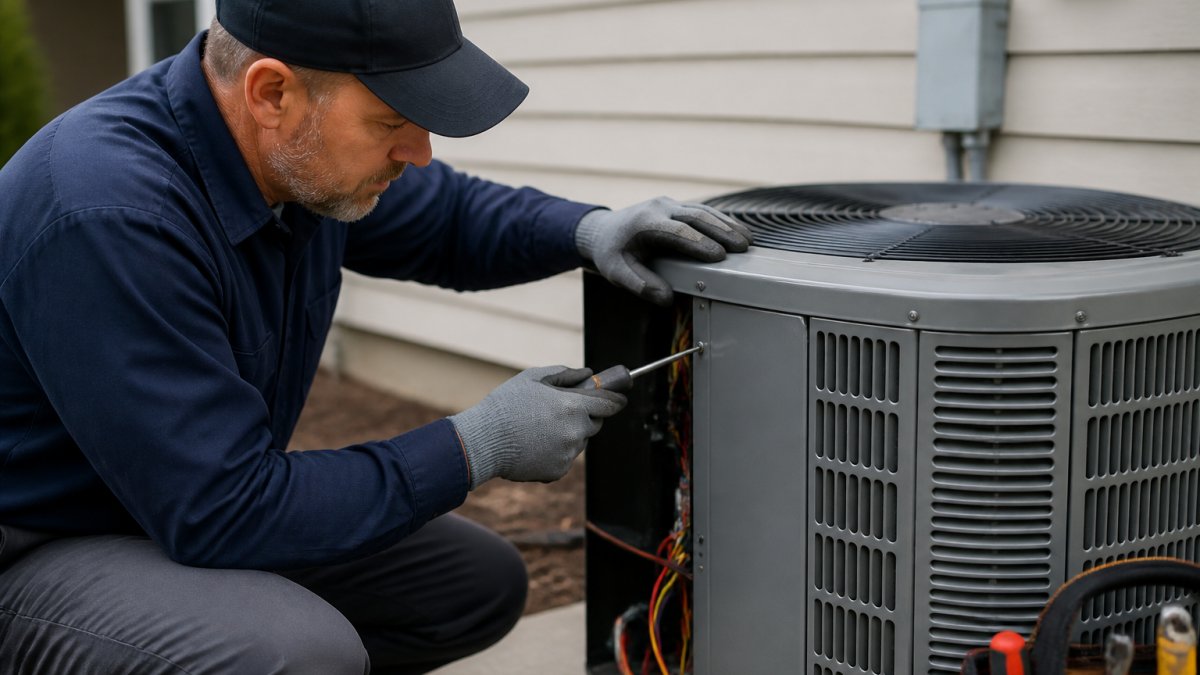
Last Updated: October 25, 2026
Quick Summary
Annual HVAC maintenance is worth it because systems tuned every year break down less, cost less to run, and last longer than systems serviced only when something fails. A tune-up catches small problems while they are cheap, before they become emergency no-heat or no-cool calls at premium rates.
- Service your system at least once per year, or twice yearly if heating and cooling equipment is separate.
- Book an AC tune-up in spring and a furnace tune-up in fall, before each heavy-use season.
- A common plan repair discount runs 10% to 15% on parts and labor.
- Many manufacturers require documented annual maintenance as a condition of warranty coverage.
- Static pressure and temperature split readings show whether your system moves the air it was designed to move.
Table of Contents
- Why Annual HVAC Maintenance Pays Off for Homeowners
- What Does HVAC Maintenance Include?
- Your Annual HVAC Maintenance Checklist by System Type
- How Often to Service Your HVAC System
- HVAC Maintenance Plan Benefits and Break-Even Math
- Indoor Air Quality, Comfort, and System Lifespan
- What Annual Maintenance Cannot Guarantee
- Scheduling Your Annual HVAC Tune-Up
- Frequently Asked Questions
Why Annual HVAC Maintenance Pays Off for Homeowners
Annual HVAC maintenance is the once-a-year service visit that keeps your heating and cooling equipment running safely, efficiently, and for its full expected lifespan. Systems tuned every year break down less, cost less to run, and last longer than systems that get attention only when something fails.
Maintenance is not a cost you absorb, it’s a cost you avoid. A tune-up catches small problems while they’re cheap; a breakdown catches you in July or January, when you’ll pay emergency rates and take whatever appointment you can get.
Lower Energy Bills and Better Operating Efficiency
A dirty system works harder for the same result.
A technician cleans the components that affect heat transfer, checks refrigerant charge or burner performance, and confirms the system runs within its designed efficiency range.
Savings vary by system age, home envelope, and how dirty the equipment was. A well-maintained newer system won’t show dramatic gains; a neglected older system often will.
Fewer Costly Repairs and Emergency Breakdowns
The most expensive HVAC repair is the one you didn’t see coming. Emergency calls carry premium rates, and a failed compressor or heat exchanger can turn a small fix into a major expense.
Early detection is the whole point of preventive maintenance.
Watch out: skipping maintenance because “it’s working fine” is a common mistake. Equipment rarely fails without warning signs. It fails because nobody was looking for them.
What Does HVAC Maintenance Include?
A standard HVAC tune-up covers inspection, cleaning, and testing across the whole heating and cooling system. The exact scope varies by equipment type, but most professional maintenance visits follow a similar structure:
- System inspection: checking electrical connections, safety controls, and overall condition
- Air filter service: replacing or cleaning filters and confirming proper airflow
- Coil cleaning: cleaning evaporator and condenser coils to restore heat transfer
- Component cleaning: clearing dust and debris from burners, blower assemblies, and drain lines
- Performance testing: measuring temperature differential, checking refrigerant charge or combustion, and confirming the system cycles correctly
For a deeper walkthrough of DIY upkeep tasks and seasonal inspection points, our residential HVAC maintenance checklist covers what homeowners can handle between professional visits.
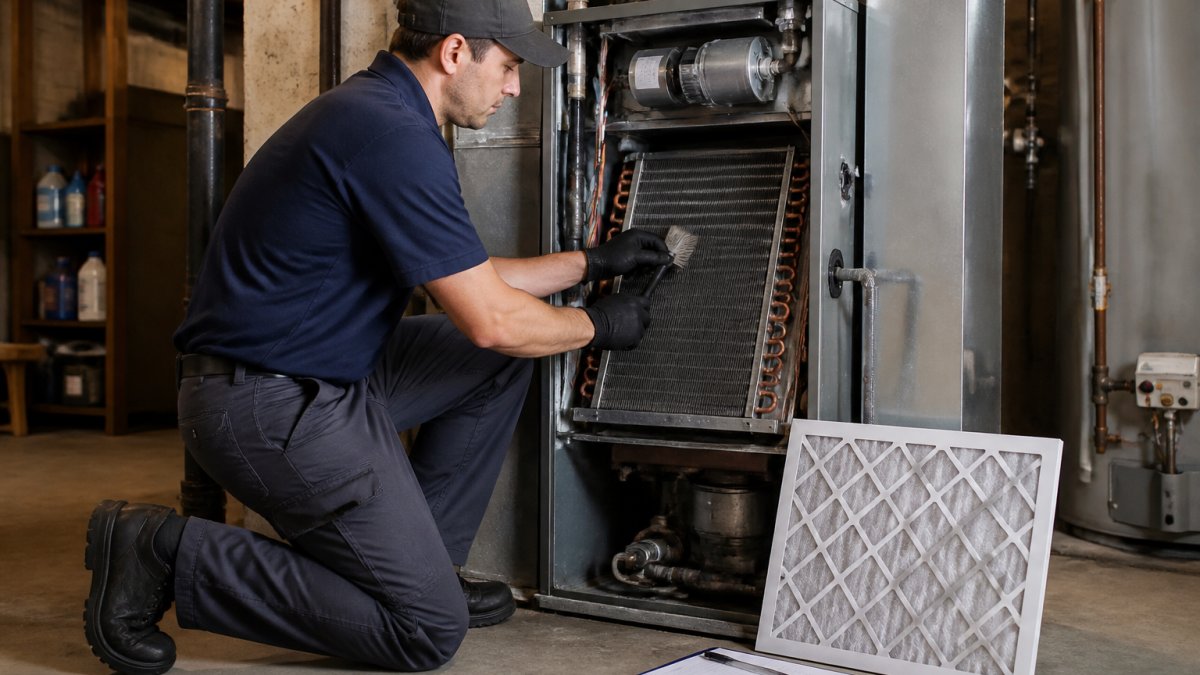
Filters, Coils, and Component Cleaning
Filter changes are the one task homeowners should own between visits. A clogged filter restricts airflow, strains the blower, and undoes much of what a tune-up accomplishes. Check it monthly during heavy-use seasons and replace it when visibly loaded.
Coil and component cleaning are where professional tools matter. Condenser coils collect grass clippings, pollen, and dust a garden hose won’t fully remove, and evaporator coils sit inside the air handler and need proper access.
Your Annual HVAC Maintenance Checklist by System Type
Different equipment needs different attention. Here’s the annual HVAC maintenance checklist we work from, organized by system type:
Furnace
- Inspect and clean burners and flame sensor
- Check heat exchanger for cracks
- Test ignition system and safety controls
- Verify flue and ventilation are clear
- Replace or clean air filter
Air Conditioner
- Clean condenser and evaporator coils
- Check refrigerant charge and look for leaks
- Test capacitors, contactors, and electrical connections
- Clear condensate drain line
- Confirm thermostat calibration
Heat Pump
- Perform all furnace and AC checks above
- Test reversing valve and defrost cycle
- Inspect outdoor unit for corrosion, especially near the lake
- Verify auxiliary heat operation
Furnace and Heat Pump Checklist Items
Heat pumps deserve a note of their own. Homes near Lake Michigan deal with salt-laden air that accelerates corrosion on outdoor units, and a heat pump runs year-round, so it accumulates wear faster than a furnace or AC alone. We check coil condition and cabinet corrosion closely on coastal-adjacent properties.
For furnaces, the heat exchanger inspection is non-negotiable. A cracked heat exchanger is a safety issue, not just a performance one, and it’s the kind of finding that only shows up when someone actually looks.
How Often to Service Your HVAC System
Heat pumps should get two visits, one before cooling season and one before heating season, since they run year-round. Homes near the lake, or systems older than ten years, benefit from the same twice-yearly schedule.
If you want a season-by-season breakdown of what to check yourself and when to call a pro, our seasonal maintenance guide lays out the timing.
Here is the service frequency the article recommends by system type.
| System | Visits per year | Timing |
|---|---|---|
| Separate heating and cooling equipment | Twice | AC tune-up in spring, furnace tune-up in fall |
| Heat pump | Two | One before cooling season, one before heating season |
| Homes near the lake or systems older than ten years | Twice | Same twice-yearly schedule |
| Any system (minimum) | Once | At least once per year |
HVAC Maintenance Plan Benefits and Break-Even Math
A maintenance plan bundles your annual visits, priority scheduling, and typically discounted repairs into one predictable cost. Whether it pays for itself depends on four things: the tune-up itself, priority service, repair discounts, and what the contract excludes.
Maintenance plans often fall into one of three structures, and the structure can matter more than the headline price:
- Single-visit plan: one tune-up per year, usually for a single system, with a modest repair discount.
- Two-visit plan: one heating tune-up and one cooling tune-up, which is the right fit for a furnace plus central AC or for a heat pump that runs year-round.
- Multi-system or whole-home plan: covers two or more systems plus add-ons such as a humidifier, and often includes filter allowances or no-charge diagnostic visits.
Here is how to run the math:
- Ask for the plan’s annual price and the standard, non-plan price for each included visit. Multiply the visit price by the number of visits the plan includes.
- Compare that visit value to the plan price. If the plan price is at or below the visit value, the remaining question is what the extras are worth to you.
- Price the priority scheduling. During a peak-demand week, non-plan customers may wait several days for a repair; plan customers typically move to the front of the queue. Assign your own value based on how disruptive a multi-day outage would be.
- Apply the repair discount to your realistic repair spending. A common discount runs 10% to 15% on parts and labor, so a $600 repair saves roughly $60 to $90. If your system is older or has a repair history, that line grows; on a new system, it is close to zero.
- Subtract the exclusions. Many plans exclude refrigerant, major components, after-hours labor, and code upgrades. Read the exclusions before you compare prices, because a cheaper plan with broad exclusions can cost more in a bad year.
A worked example: suppose a two-visit plan costs $240 per year and each tune-up is $110, so the included visits are worth $220, the plan is $20 more than the visits alone.
Ask the provider to quote the plan price, the standard visit price, the repair discount, and the exclusions in writing before you sign. A plan that will not put those four numbers on paper is hard to evaluate.
Warranty terms can shift the math in the plan’s favor. Many manufacturers require documented annual maintenance as a condition of coverage, and a plan produces a service record automatically. If your equipment is still under warranty, check the terms first; losing coverage over a missing maintenance record can cost far more than the plan fee.
Indoor Air Quality, Comfort, and System Lifespan
Clean equipment moves air better, and better airflow shows up as consistent heating and cooling room to room.
A technician can measure this instead of guessing.
Indoor air quality follows the same logic. For dust, humidity, and whole-home HVAC upgrades, see our indoor air quality solutions guide.
Equipment longevity is the quiet payoff. A system that runs longer cycles because of restricted airflow wears its blower motor and compressor harder, and those are among the most expensive components to replace.
Comfort, air quality, and lifespan are not separate benefits; they are three outcomes of the same thing, which is a system moving the right amount of air at the right temperature with clean components. Measure airflow and temperature split at every tune-up and you are tracking all three at once.
What maintenance cannot do is reverse a sizing problem, fix ductwork that was never sealed, or compensate for a system that was installed incorrectly. If comfort problems persist after a tune-up, the next step may involve further evaluation.
What Annual Maintenance Cannot Guarantee
Maintenance is not a warranty against failure, and we won’t pretend otherwise. A well-maintained system can still fail. Components wear out, and some failures are simply not predictable from an inspection.
What maintenance does is shift the odds: it catches the problems that are catchable, keeps the system running within spec, and gives you a documented service history.
Watch out: any provider promising that maintenance will eliminate all breakdowns is overselling. It’s important to ask what the visit actually includes and what it doesn’t.
Scheduling Your Annual HVAC Tune-Up
Book your tune-up before the season it protects, not during it. Spring for cooling, fall for heating. Peak-demand weeks are the worst time to need service, and plan customers get priority when the schedule fills.
Signs you need service between annual visits:
- Unusual noises, rattling, or banging on startup
- Weak airflow from vents
- Rising utility bills with no change in usage
- Musty odors or excess dust
- The system short-cycles or runs constantly
If any of these show up, don’t wait for the annual visit. Call it in.
Winter in Southeast Wisconsin and Northeast Illinois doesn’t negotiate, and neither should your heating system. Peters Heating & Cooling provides honest, licensed service with clear pricing and a repair-first approach, backed by our Better Business Bureau A+ accreditation.
Frequently Asked Questions
Can annual HVAC maintenance lower energy bills?
A clean system moves air with less resistance, so the blower and compressor run shorter cycles. Dirty filters and coils force equipment to work harder, which shows up on your electricity bills. Annual HVAC maintenance keeps airflow and refrigerant charge in spec, and the efficiency rating on your unit only holds when components are clean. Expect modest but steady savings, plus fewer peak-demand surprises in extreme weather.
How often should an HVAC system be serviced?
Once a year for each system is the baseline: a furnace tune-up before heating season and an air conditioner check before cooling season. Heat pumps run year-round, so they benefit from two visits. Homes near Lake Michigan with salt-laden air, or properties with pets and heavy dust, may need filter changes more often between visits. Ask your technician to flag anything that needs attention between annual inspections.
Are HVAC maintenance plans worth it?
A maintenance plan bundles the annual tune-up with priority scheduling, discounted repairs, and no out-of-pocket surprises on routine service. The value depends on how much you would otherwise pay for a service call plus any repair discounts. Compare the plan fee against one annual visit and the cost of a single emergency call, then factor in the convenience of early problem detection before a breakdown.
Does regular HVAC maintenance extend equipment life?
Yes. Wear and tear compounds when bearings run dry, coils stay dirty, and airflow is restricted. Annual service catches small issues like a failing capacitor or loose belt before they damage the compressor or heat exchanger. Most furnaces and air conditioners are built for 15 to 20 years, and consistent maintenance is the main lever a homeowner controls. Skipping visits shortens that window and raises repair costs.