

Table of Contents
- Average Cost to Replace an AC Unit: What Homeowners Actually Pay
- What’s Included in a Replacement Quote
- AC Replacement Cost by Home Size
- AC Repair vs. Replacement: How to Decide
- Cost to Replace an AC and Furnace Together
- AC Replacement Financing and Payment Options
- How to Evaluate a Contractor Quote
- Frequently Asked Questions
Last Updated: October 21, 2026
Average Cost to Replace an AC Unit: What Homeowners Actually Pay
The average cost to replace an AC unit is not a single number you can pin to a wall. It is a range shaped by tonnage, efficiency rating, ductwork condition, electrical capacity, and how much of the system you replace.
Below, we break down what drives the figure, how to read a quote line by line, and when repair beats replacement. We also show you the decision framework we use on site, because that is what actually protects your wallet.
The sticker price of the condenser is rarely the biggest line item. Labor, old unit removal, permits, and any ductwork or electrical corrections often decide whether a project stays modest or climbs.
What’s Included in a Replacement Quote
A complete AC replacement quote covers far more than the box outside. The problem is that most quotes bury the components in a single total, which makes them impossible to compare. Below is the same list of components with the typical share of project cost each one represents, so you can see where the money actually goes and audit a quote line by line.
- Equipment: condenser, evaporator coil, and the air handler or furnace interface. This is usually the largest single line item, commonly the majority of a straightforward swap.
- Labor: removal of the old unit, installation, brazing, vacuuming, and charging the system. Labor is the second-largest line and scales with project complexity, not just hours.
- Line set and refrigerant: new or flushed lines, plus refrigerant charge by weight. A new line set on a long run adds cost; a flush on a short run is cheaper.
- Electrical work: disconnect, whip, breaker sizing, and any panel upgrades. A panel that cannot carry the new circuit is the most common surprise add-on.
- Ductwork: sealing, resizing, or repairs where static pressure is off. Often excluded from a base quote and added as a change order.
- Permits and inspection: required in most jurisdictions for a system swap, and usually a fixed fee rather than a percentage.
- Thermostat and controls: programming and commissioning. A smart thermostat is often an upgrade line, not a base inclusion.
- Old unit removal and disposal: haul-away and refrigerant recovery. Small line, but one that should never be missing.
How the components stack up in a typical quote
Exact figures vary by market, equipment tier, and the condition of the home, but the relative shape of a quote is consistent. A base replacement quote usually breaks down roughly like this:
| Component | Typical share of project cost | What moves it |
|---|---|---|
| Equipment (condenser, coil, air handler) | Largest single line | Efficiency tier, tonnage, brand, single- vs. variable-speed |
| Labor and commissioning | Second-largest line | Access, line-set length, electrical scope, duct condition |
| Line set and refrigerant | Moderate | New vs. flushed lines, run length, refrigerant type |
| Electrical | Small to moderate | Existing panel capacity, disconnect and whip condition |
| Ductwork | Variable, often excluded | Static pressure, leakage, sizing for new airflow |
| Permit and inspection | Small, fixed | Local jurisdiction fee schedule |
| Thermostat and controls | Small | Base vs. smart thermostat |
| Removal and disposal | Small | Haul-away distance, refrigerant recovery |
A quote that lists only “AC installation” and one lump sum is a quote you cannot audit. Ask for the breakdown before you sign, and ask specifically which lines are included and which are excluded. The exclusions are where change orders come from.
The most common mistake we see is comparing two quotes by total price alone. A lower total often excludes the line set, permit, or duct sealing, which then appears as a change order mid-project. Compare the included scope, not the bottom line.
What to ask for in writing
Before you sign, request the equipment model numbers, the efficiency ratings, the permit fee as a separate line, the duct and electrical scope in plain language, and the labor warranty terms stated separately from the equipment warranty. A contractor who cannot or will not itemize is telling you something about how the project will be managed.
AC Replacement Cost by Home Size
Home size drives system capacity, and capacity drives equipment cost. A smaller home needs fewer tons of cooling, a shorter line set, and less labor.
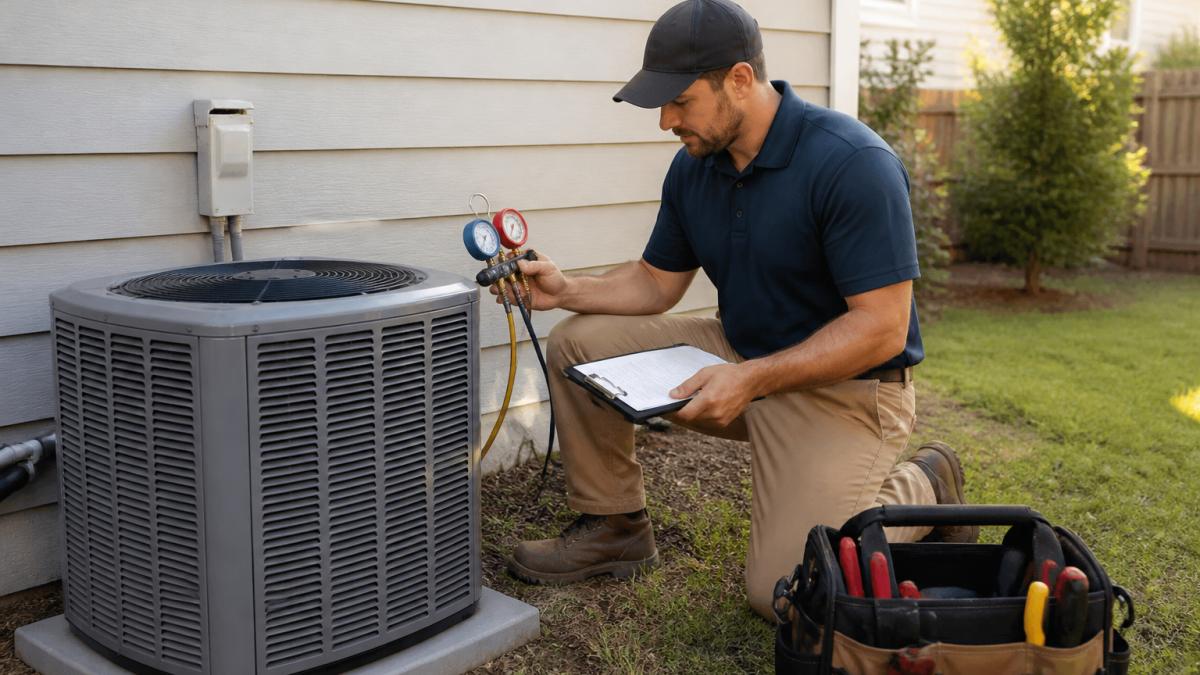
Sizing is not guesswork. A proper load calculation, performed to ACCA Manual J standards, measures square footage, window area, insulation, ceiling height, and local design temperatures.
Here is how the variables stack up by home profile:
| Home Profile | Typical Capacity | What Drives the Quote |
|---|---|---|
| Smaller single-story home | Lower tonnage, single-stage | Short line set, simple duct layout |
| Mid-size two-story home | Mid tonnage, two-stage common | Longer runs, zoning considerations |
| Larger home with additions | Higher tonnage, variable-speed | Duct resizing, multiple zones |
| Older home, original ducts | Sized to corrected load | Duct sealing or partial replacement |
The takeaway: square footage is a starting point, not the answer. Ask for the load calculation in writing.
AC Repair vs. Replacement: How to Decide
Most price pages stop at “replace if the repair costs more than half a new system.” That rule of thumb is too blunt to act on. The decision is really a comparison of four numbers: the repair bill, the age of the equipment, the efficiency gap between old and new, and the expected remaining life of the rest of the system. Here is the framework we use on site, with the math shown.
Step 1: Put the repair in context of remaining life
A repair is only worth it if the equipment has enough life left to earn back the cost. A common practitioner approach is to multiply the age of the unit by the repair cost and compare that figure to the price of a new system.
Worked example: an 11-year-old condenser needs a $1,400 blower motor. 11 × $1,400 = $15,400. If a comparable replacement runs $6,500, the math points to replacement.
Step 2: Check refrigerant type before authorizing a recharge
Refrigerant availability changes the repair calculus more than any other single factor. Equipment charged with R-22 has been subject to a phasedown under the Environmental Protection Agency’s stratospheric ozone rules, and reclaimed R-22 is scarce and expensive. A leak repair on an R-22 system can cost more than the part because the recharge itself is priced at a premium. Newer equipment uses R-410A or one of the newer low-GWP blends, which are widely available.
Step 3: Compare efficiency, not just price
A 20-year-old unit may run at a seasonal energy efficiency ratio (SEER) of 10 or below, while current minimum-efficiency equipment is rated at 14.3 SEER2 or higher under the Department of Energy’s updated test standards. The gap shows up on your electric bill every summer month. A repair that keeps an inefficient compressor alive is a repair that keeps paying for itself in operating cost.
Step 4: Weigh repair frequency and the rest of the system
One major repair on a healthy system is a data point. Two or more major repairs in a 24-month window is a pattern. Pair that with the condition of the furnace, coil, and ductwork: a failing coil on top of a 20-year-old furnace is a different decision than the same coil on a furnace with years of life left. Replacing the coil alone on an aging furnace often means paying labor twice within a few years.
A quick decision table
| Situation | Lean repair | Lean replace |
|---|---|---|
| Age × repair cost vs. replacement price | Product below replacement price | Product exceeds replacement price |
| Refrigerant type | Current refrigerant, widely available | R-22 or other phased-down refrigerant |
| Efficiency gap | Existing unit near current minimum | Existing unit far below current minimum |
| Repair history | First major repair | Two or more major repairs in 24 months |
| Rest of system | Furnace and ducts healthy | Furnace or ducts near end of life |
Ask the technician to show you the failed part and explain what caused the failure. A compressor that died from a refrigerant leak is a different conversation than one that died from a failed capacitor. The cause changes the recommendation, and a good technician will walk you through it without pressure.
If the framework points to replacement, the next question is what the job should cost, which is where an itemized quote matters more than a single total.
Cost to Replace an AC and Furnace Together
Replacing the air conditioner and furnace at the same time usually costs less than two separate projects.
There are practical reasons to pair them beyond price. A new furnace paired with a new coil lets the contractor verify airflow and static pressure across the whole system.
Timing matters too. If the furnace is already near the end of its life, replacing both now avoids paying twice for labor and a second permit.
AC Replacement Financing and Payment Options
Financing turns a large one-time expense into a monthly payment, and most homeowners use it. Options generally include manufacturer-backed promotional financing, third-party home improvement lenders, and standard installment plans through the contractor.
Before choosing, compare three things: the annual percentage rate, the term length, and whether there is a prepayment penalty.
We offer financing so a system failure does not force a rushed decision, and we walk through the terms before any work begins. Ask for the full disclosure document, not just the monthly figure.
How to Evaluate a Contractor Quote
A good quote is specific, itemized, and written. Use this checklist before you commit:
- Equipment model numbers and efficiency ratings listed
- Load calculation provided or offered
- Line set, refrigerant, and thermostat included or explicitly excluded
- Permit and inspection fees shown as line items
- Ductwork and electrical scope described
- Old unit removal and disposal included
- Labor warranty terms stated separately from equipment warranty
- Payment schedule tied to milestones, not all upfront
- License and insurance certificate provided on request
- Financing terms in writing, including APR and prepayment rules
Verify licensing and insurance directly with the issuing authority rather than accepting a verbal assurance. The Better Business Bureau and your state licensing board are reasonable places to confirm standing.
Never pay the full contract price before the work is complete and inspected. A deposit is normal; full prepayment is not.
Replacing an air conditioner is a large, infrequent purchase, and the quotes you receive will not always be easy to compare. The difference usually comes down to what is itemized, what is excluded, and whether the contractor sized the system properly.
Frequently Asked Questions
Is it better to repair or replace an AC unit?
The decision usually comes down to age, repair cost, and efficiency. If your unit is past roughly 12 to 15 years, needs a repair that costs a large share of a new system, or uses older refrigerant that is expensive to recharge, replacement often makes more financial sense. A repair that costs a small fraction of replacement and buys several more years is usually worth doing. Ask your contractor for both numbers side by side, plus the expected efficiency gain, so you can compare total cost over the next five years rather than just this month’s bill.
How much does a new AC cost for a 2,000-square-foot house?
AC replacement cost by home size depends mostly on the tonnage and efficiency rating your home needs, not the square footage alone. A 2,000-square-foot home in a mixed climate typically needs a system in the 3 to 4 ton range, and higher-SEER equipment, ductwork changes, and electrical upgrades all move the number. Because pricing varies by region and equipment, request an itemized quote for your specific home. Peters Heating & Cooling has pricing available on its website and can walk you through what a correctly sized system for your square footage involves.
What factors affect the cost of AC replacement?
The biggest drivers are system size and cooling capacity, efficiency rating (SEER2), equipment brand tier, and whether the job includes ductwork, electrical work, permits, or refrigerant line changes. Labor cost and project scope matter too: a straightforward swap on an existing pad and disconnect costs less than a full changeout with new lines and a thermostat. Regional pricing and local labor rates also shift the total. Get a written, itemized quote so you can see equipment cost, labor cost, and any additional costs separately instead of one bundled figure.
Can I finance a new AC unit?
Yes. AC replacement financing is common, and many contractors offer monthly payment plans through third-party lenders or manufacturer programs. Terms vary widely, so compare the APR, the length of the term, and whether there is a prepayment penalty before signing. Some plans offer promotional no-interest periods if paid in full within the window. Ask whether the financing covers the full installed cost, including permits and electrical work, so you are not surprised by a gap. Peters Heating & Cooling offers financing options and can explain which plans fit your budget.